

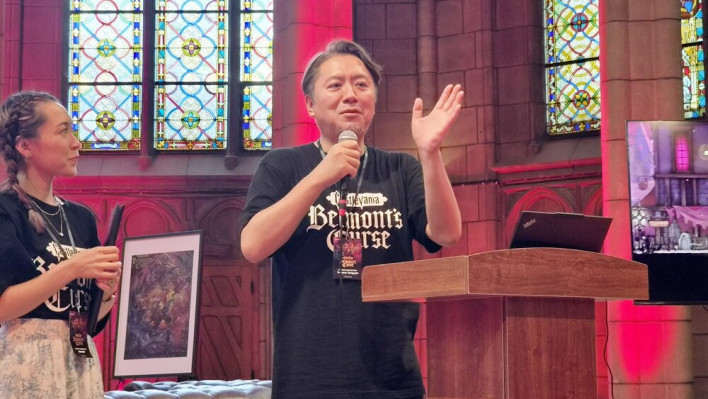
On June 19, 2026, an introduction and hands-on event for ‘Castlevania: Curse of the Belmonts’ was held at the ‘Chapelle de Jeanne d’Arc’ in Paris, France. The event featured a panel including KONAMI producer Tsutomu Taniguchi, as well as Emmanuel Nouai and Bérenger Dupré from the France-based developer Evil Empire.
‘Castlevania: Curse of the Belmonts’ is the first authentic 2D entry in the series in 18 years. The development team stated that they built the game with the goal of ‘returning to the roots,’ explaining that as the series celebrates its 40th anniversary, the project aims to provide a modern reinterpretation of the essence of the classic Castlevania series.
A defining feature of this title is that it is set primarily in France. Paris in 1499 has fallen into darkness due to mysterious circumstances, and the protagonist is Rose Belmont, the daughter of Trevor Belmont (Ralph C. Belmont in the original work), who was the main character of the animated series. Her mother, Sypha Belnades, also makes an indirect appearance.

Unlike previous titles that typically used the ‘Demon Castle’ itself as the stage, this game features various locations throughout Paris as fields. This means the game depicts the journey from Paris toward the Demon Castle. Having played through ‘Curse of the Belmonts,’ which incorporates numerous changes and new attempts, I have compiled my impressions below.
A Game Structure Defined by the ‘Whip’
While ‘Curse of the Belmonts’ introduces several new systems, the most significant is undoubtedly the ‘Arcana Whip.’ The whip has always been an iconic weapon in the Castlevania series, but in this title, while it is not a weapon in the traditional sense, it functions as a vital tool that drives the game’s core mechanics.
The whip has two primary uses: it can be hooked onto ‘rings’ scattered throughout the map for traversal, or used to grapple directly onto enemies for a quick approach. This simple yet symbolic system serves as the core of ‘Castlevania: Curse of the Belmonts.
In the process of sequentially exploring the expansive 2D maps characteristic of the Metroidvania genre, the Arcana Whip is effectively the star. Most topographical obstacles must be overcome using this whip, and timing your release while swinging from a ring becomes a test of skill that determines whether you successfully clear an area.
The ability to grab and dash toward enemies is also highly useful. It can be used to close the distance on enemies performing ranged attacks, and you can even weave in a special ‘dash attack’ while approaching. However, its greatest utility lies in using the enemies themselves as a means to traverse the terrain. You can grab flying enemies to reach otherwise inaccessible areas, or use your whip on enemies in the back row to bypass front-line obstacles and create new attack routes.

Above all, this ‘Arcana Whip’ exists in various forms. While only the basic whip is available in the game, quest information suggests that at least three different types exist.
Combat Divided by Tarot Cards and Weapons
If the whip is the key to movement, the core of combat lies in weapons and spells. Each spell exists in the form of a tarot card, which is unlocked one by one throughout gameplay. As is common in many games, the system allows you to select and utilize one from a variety of available spells.
Weapons are also discovered as you play. There are seven types in total; the hands-on build allowed for the use of the basic ‘Sword,’ the dual-wielded ‘Cestus,’ the ‘Spear,’ and the ‘Harpe and Aegis’ set. I also confirmed the existence of a two-handed sword, though I did not have the chance to play with it myself.

Every weapon possesses unique actions and functions.
For instance, the Cestus features increased damage with each successful hit, and its dash attack is an uppercut that launches enemies into the air, neutralizing them. For the two-handed sword, holding and releasing the X button allows for a powerful charged attack, while the spear can be thrown at enemies when using a charged attack.

Because each spell and weapon offers a different combat style, unique actions, and situational responses, ‘Castlevania: Curse of the Belmonts’ allows for a vast array of combat combinations.
You have the option to stick with the iconic ‘Grand Cross’ technique or concentrate on using a petrification beam to transform enemies into stone.
Regardless of your decision, the game offers the flexibility to switch your equipment and spells to match your preferred weapon or playstyle.


Engaging and Customizable Gameplay
‘Castlevania: Curse of the Belmonts’ represents an outstanding gaming experience. The developers’ commitment to ‘modernizing a longstanding series’ truly shines through in this title. While it’s important to note that the hands-on build isn’t the final version, and I only experienced a portion of the game—meaning potential issues in the latter half or hidden flaws—the initial gameplay was incredibly rewarding and a true embodiment of the Metroidvania genre.
The game doesn’t hold back on challenges. Even the first boss presents a significant hurdle; many players, including myself, attempted to defeat the first boss multiple times. Thankfully, ‘Curse of the Belmonts’ offers extensive difficulty settings. Players can tweak everything from damage modifiers for both themselves and enemies to the availability of respawn points. This allows for a more relaxed gaming experience if desired.

However, one aspect that remains unchanged by difficulty settings is the traversal of the game map, a pivotal element in any Metroidvania title. While the level design isn’t as punishingly difficult as ‘Super Meat Boy’—most traps can be navigated with practice—there were instances where finding the correct path forward proved challenging. At times, I found myself wandering aimlessly, unsure of the next step.
While these occurrences were infrequent, the fact that many other players at the event encountered similar challenges in certain sections indicates room for improvement in providing clearer guidance. With three months until release, I believe this issue can be effectively addressed.

In conclusion, ‘Castlevania: Curse of the Belmonts’ upholds the esteemed legacy of the ‘Castlevania’ series. Initial feedback criticizing the game for being ‘too bright’ compared to past titles is unfounded, as these elements serve to provide visual contrast. The actual gameplay environments are not overly bright as suggested.
While it’s important to recognize that the demo build was tailored to showcase the game’s strengths, the overall experience was gratifying and has left me eagerly anticipating the full release.

Please rewrite the following sentence for me.