
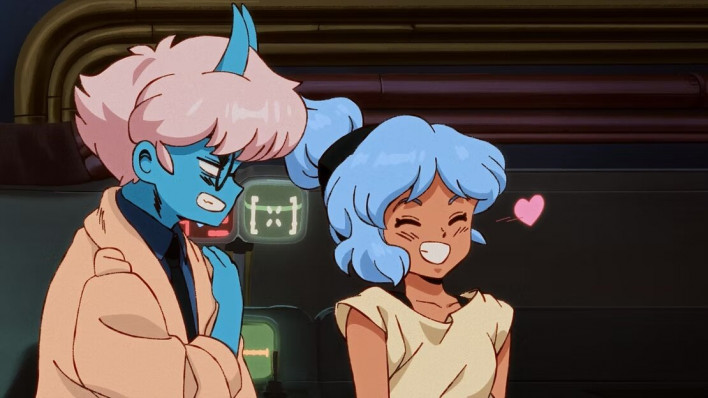
‘Orbitals’ by Shapefarm, which appeared like a comet at the last The Game Awards, is a title that captured the attention of many gamers the moment it was unveiled. Split-screen co-op games have become a relatively familiar genre to the public through titles like ‘It Takes Two’ and ‘Split Fiction.’ Of course, if that were all it had to offer, it might not have garnered so much interest. The biggest draw of ‘Orbitals’ is its visuals. With an aesthetic reminiscent of 80s and 90s anime, it possesses a charm that is impossible for any gamer with nostalgia for that era to ignore.
However, there were concerns. The developer, Shapefarm, was virtually unknown. While many gamers were excited by this sudden arrival, they also worried whether such an attractive game could actually be delivered. Fortunately, Shapefarm was not truly unknown; they were a studio that had built solid development capabilities by participating in outsourcing for numerous games.
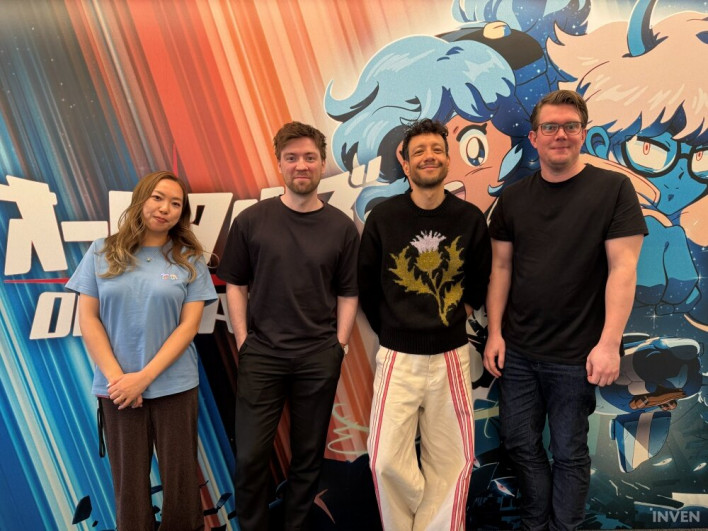
Now, over a decade after its founding, Shapefarm is finally releasing its own game to the world. It is hard to imagine a developer that has created a more thoroughly anime-like experience; from the 12/24 FPS character movement to the 2D cutscenes completed in close collaboration with Studio Massket, the entire game is designed to feel like a single animated work. Ahead of its release this summer, we visited Shapefarm’s Japanese headquarters to meet Creative Director Marcos, Game Director Jacob, Lead Animator Johannes, and Operations Manager Megumi to hear about the passion behind ‘Orbitals’ and the stories behind the scenes.
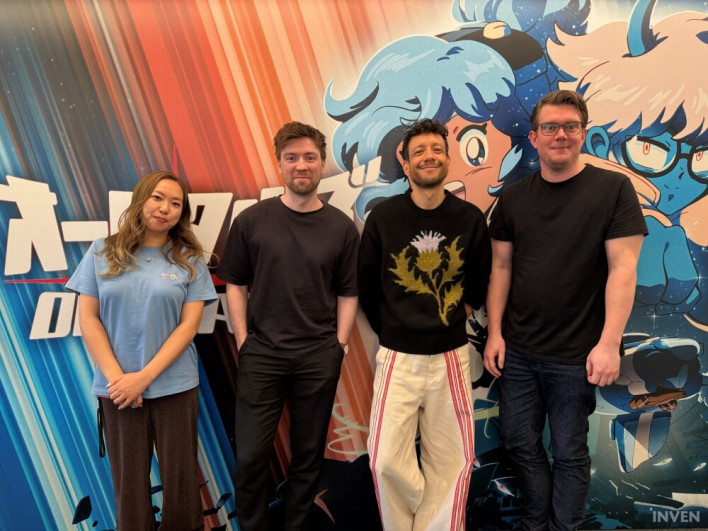
Marcos Ramos (Creative Director), Johannes Varmedal (Lead Animator/Art Director)
Nostalgia for 80s/90s Anime: Crafting a Playable Animation
Q. Could you please start with a brief introduction.
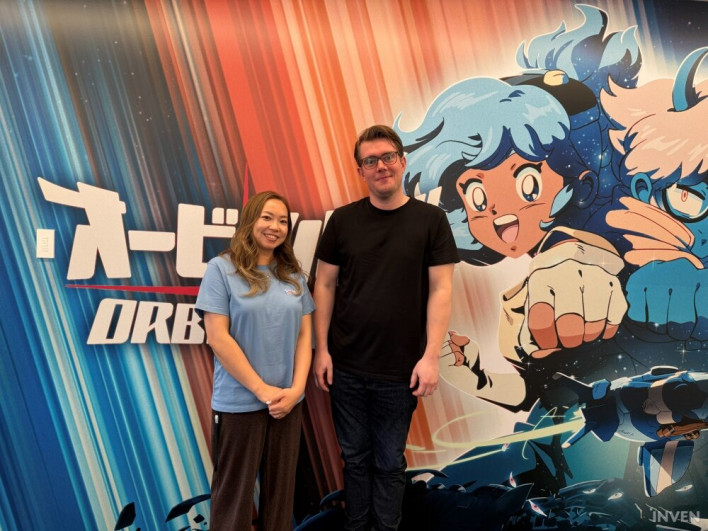
Johannes = My name is Johannes. I am in charge of background graphics and technical art.
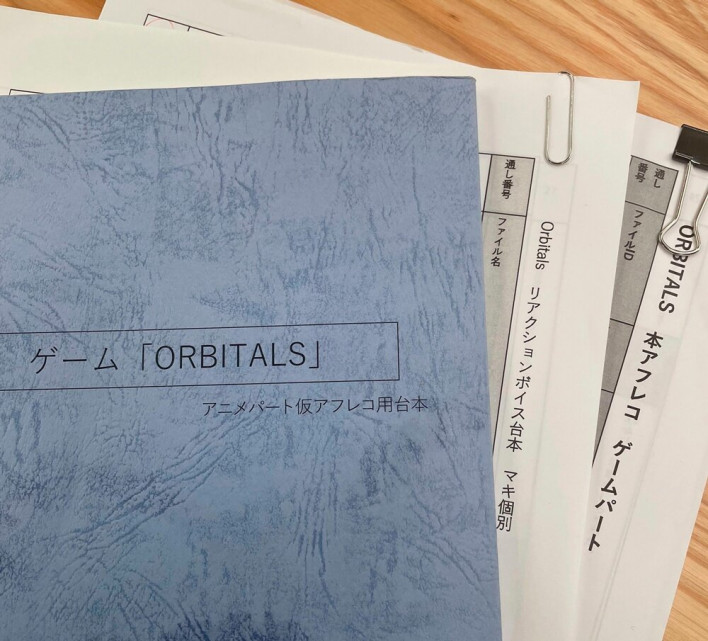
Megumi = I am Megumi Varmedal, the Operations Manager. Within the company, I handle production tasks for our Japanese clients related to the development of ‘Orbitals.’ To put it simply, you can think of me as managing things like the schedule for Studio Massket, which handled the 2D cutscene animation, and the voice acting recordings.
Q. The most prominent feature of ‘Orbitals’ is undoubtedly its 80s-90s Japanese anime art style. Is there a specific reason you chose that era’s style rather than just a generic anime look?
Johannes = I think our Creative Director, Marcos, would be better suited to answer that, but I believe it is also a style that the entire development team loves. Basically, if you look at the projects Shapefarm has participated in, you will see many stylized art styles. Since we have handled a lot of subcontracting work for animation-based games, our team’s know-how is specialized in implementing that style.
Because of that, from the early prototyping stage, everyone on the team—who all love anime—would say, “We definitely want to make an anime-style game someday.” As a result, it happened quite naturally. Once we finalized the 80s-90s visual style, we studied the rendering methods of that era’s animation and built our workflow accordingly, which allowed us to achieve the current look.
Q. As an aside, you mentioned watching a lot of 80s and 90s anime. Do you have any personal favorites?
Johannes = Personally, my favorite work from that era is the film ‘Royal Space Force: The Wings of Honnêamise.’ It is a truly magnificent work, and I think the art is incredibly beautiful. I also love the BGM. Of course, I don’t only like 80s and 90s anime; I recently enjoyed watching ‘Frieren: Beyond Journey’s End.’
Megumi = I also love the work Johannes just mentioned, but if I had to pick my personal favorite, it would be ‘Evangelion.’ Beyond that, I watch everything from ‘Sailor Moon’ and ‘One Piece’ to relatively recent hits like ‘Demon Slayer.’
Q. The 80s-90s anime style gives off a vibe similar to ‘Nausicaä’ or Ghibli films from that era. Was that intentional?
Johannes = We referenced a wide variety of works when setting the art direction. It is difficult to say we referenced just one specific work because we took elements we liked from various films and series for each part, such as background art, characters, and animation.
To explain in detail, for the atmosphere and quality of the backgrounds, we referenced SF-style space operas like ‘Akira’ and ‘Ghost in the Shell.’ On the other hand, for characters and animation, we looked at more charming and cute series from the 80s. Marcos, in particular, loves early ‘Dragon Ball,’ and the unique charm of those characters provided a lot of inspiration.
Q. Implementing such a unique visual style into a game couldn’t have been easy. Did you face any difficulties?
Johannes = As you guessed, it wasn’t easy. The 80s-90s anime focus was actually a bit of a hurdle. While the team members were all anime fans from the start, quite a few of them hadn’t deeply experienced the Showa-era anime from that time, which was essential for capturing the ‘feel’ of ‘Orbitals.’
Furthermore, the fact that the development team is scattered across the globe—from our headquarters in Japan to Europe and New Zealand—was also a challenge. It took a lot of time to align the direction of the art and push the final quality, especially regarding communication and feedback. In the beginning, this was our biggest challenge.
There were technical aspects as well.
We dedicated a significant amount of time to refining our rendering values in Unreal Engine 5 to achieve that nostalgic 80s-90s anime feel. Our efforts in trial and error were crucial in reaching the current quality of the game.
Megumi mentioned that the team invested a lot of time in research and study to establish the unique style of the game. By the time voice casting began, the character traits of Maki and Omura were already well-defined. Maki is portrayed as energetic and mischievous, while Omura is depicted as cynical and quiet but harboring a passionate side.
The team aimed to create an ‘animated experience you can play’ by seamlessly blending 2D cutscenes with gameplay. Collaborating closely with Studio Massket, they ensured quick feedback exchange to achieve the desired result.
When discussing the choice of 30 FPS for the game, Johannes mentioned that it was to maintain performance due to split-screen rendering for co-op play. Despite being a global team, Shapefarm’s decision to establish the company in Japan was influenced by their love for Japanese anime and games.
Megumi expressed her love for all the characters in the game, with a special mention of Hiroto, the cat, and Omura. The attention to detail in character implementation aims to make players enjoy and appreciate the unique traits of each character.
To the Korean gamers eagerly anticipating the game for its eye-catching anime style, Megumi extended a warm invitation to experience the delicate and cute animations that ‘Orbitals’ has to offer. Not only are the protagonists cute, but the movements of the small creatures you encounter while playing ‘Orbitals’ are also adorable. I would recommend paying attention to these details and enjoying the game to the fullest.
Johannes hopes that players will explore the world of ‘Orbitals’ together, finding joy in solving puzzles and feeling the thrill of action.
Shapefarm, the developer of ‘Orbitals,’ has a long history of outsourcing for AAA games. With Marcos as the Creative Director and Jacob as the Game Director, they bring a wealth of experience to this self-developed game.
Although Shapefarm has been primarily known for outsourcing work, their dream of creating their own game has finally come true with ‘Orbitals.’ Supported by Kepler Interactive, the team embarked on full-scale development to bring their vision to life.
Based in Japan, Shapefarm has deep ties to the country and a love for Japanese culture. This connection influenced their decision to develop the game in Japan, incorporating elements of Japanese culture into ‘Orbitals.’

While comparisons to ‘It Takes Two’ and ‘Split Fiction’ are inevitable due to the split-screen co-op nature of ‘Orbitals,’ Game Director Jacob emphasizes that the game has unique elements that set it apart. From gameplay design to storytelling and audio, ‘Orbitals’ offers a fresh and distinct experience for players. What inspired the development of the game ‘Orbitals’ in terms of animation and games?
Marcos = While creating ‘Orbitals,’ we made sure not to just copy one specific animation. We drew inspiration from various 80s-90s animations to create a unique style for the game. The machines and mechanics in the game have a rusty and worn feel, influenced by ‘Venus Wars’ and Doronjo from the ‘Time Bokan’ series.
We aimed for distinct and simple character designs similar to ‘Ranma 1/2,’ ‘Sailor Moon,’ and ‘Inuyasha’ to create a sense of familiarity for players, especially children. The storyline is centered around adventure, similar to early ‘Dragon Ball,’ with a mix of exciting and sometimes dark or sad scenes that anyone can relate to. For more details on game inspiration, I’ll let Jacob elaborate.
Jacob = Our team drew inspiration from a wide range of games during the development of ‘Orbitals.’ Personally, the co-op DLC for ‘Portal 2’ was a significant reference for building the cooperative system in our game.
Surprisingly, we also looked to ‘Mario Party’ for inspiration, especially in terms of player-centered interactions during mini-games. We aimed to incorporate that engaging player dynamic into a story-driven game seamlessly. Additionally, ‘The Legend of Zelda’ influenced our puzzle design and the overall sense of adventure in the game.
Question: What is the total playtime of the game?
Jacob = I’m sorry, but we’re not able to disclose that information at this time.
Question: There are many gamers in Korea eagerly anticipating the game due to its captivating anime style. Could you share a message with these Korean gamers?
Jacob = First and foremost, I hope you enjoy ‘Orbitals’ and that it brings you valuable time with your family, significant others, and friends. Personally, I have a deep appreciation for Korean culture. ‘StarCraft’ has been one of my favorite games since I was young, and I am a fan of K-pop and dramas. My visit to Korea at 18 to attend a ‘StarCraft’ tournament is a cherished memory. I hope Korean players find a sense of familiarity with ‘Orbitals’.
Marcos = Shapefarm is a diverse studio with team members from various countries. I hail from Argentina, while Jacob is from Sweden, but our shared passion for animation and games unites us all. For those who appreciate ‘Orbitals’—whether you have fond memories of playing games with friends in your youth or are anime enthusiasts—I hope you feel a connection to our development team. This game serves as a tribute to Japanese animation and gaming as a whole. It would bring me joy if you could also sense that connection through ‘Orbitals’.
Please rewrite the given text for me.