Table of Contents
Intel D-Series GPUs: Unveiling the Future of Gaming Graphics with Up to 512 GB Memory
Intel has taken the gaming world by storm with its upcoming Crescent Island “D-Series” GPUs, showcasing cutting-edge technology on a liquid-cooled OAM card. The latest updates from Intel reveal the innovative OAM designs and the introduction of first dual-chip solutions for the D-Series family. These revelations were made public on social media and during the OCP 2026 event, generating significant excitement among gaming enthusiasts.
Revolutionary Xe3P Architecture
The D-Series GPUs, previously known as Crescent Island, will be powered by the state-of-the-art Xe3P architecture. This updated design offers a host of improvements over its predecessor, the Xe3 architecture. Some notable enhancements include:
- Agentic AI Ready: Equipped for high memory capacity and sustained compute
- LPDDR5x: Higher density and lower power consumption for enhanced reliability
- AI Optimized: Featuring larger context lengths, higher memory capacity, and improved performance
- Prefill Optimized: Designed for high FLOP/W performance in compute-bound workloads
Impressive Specs and Performance
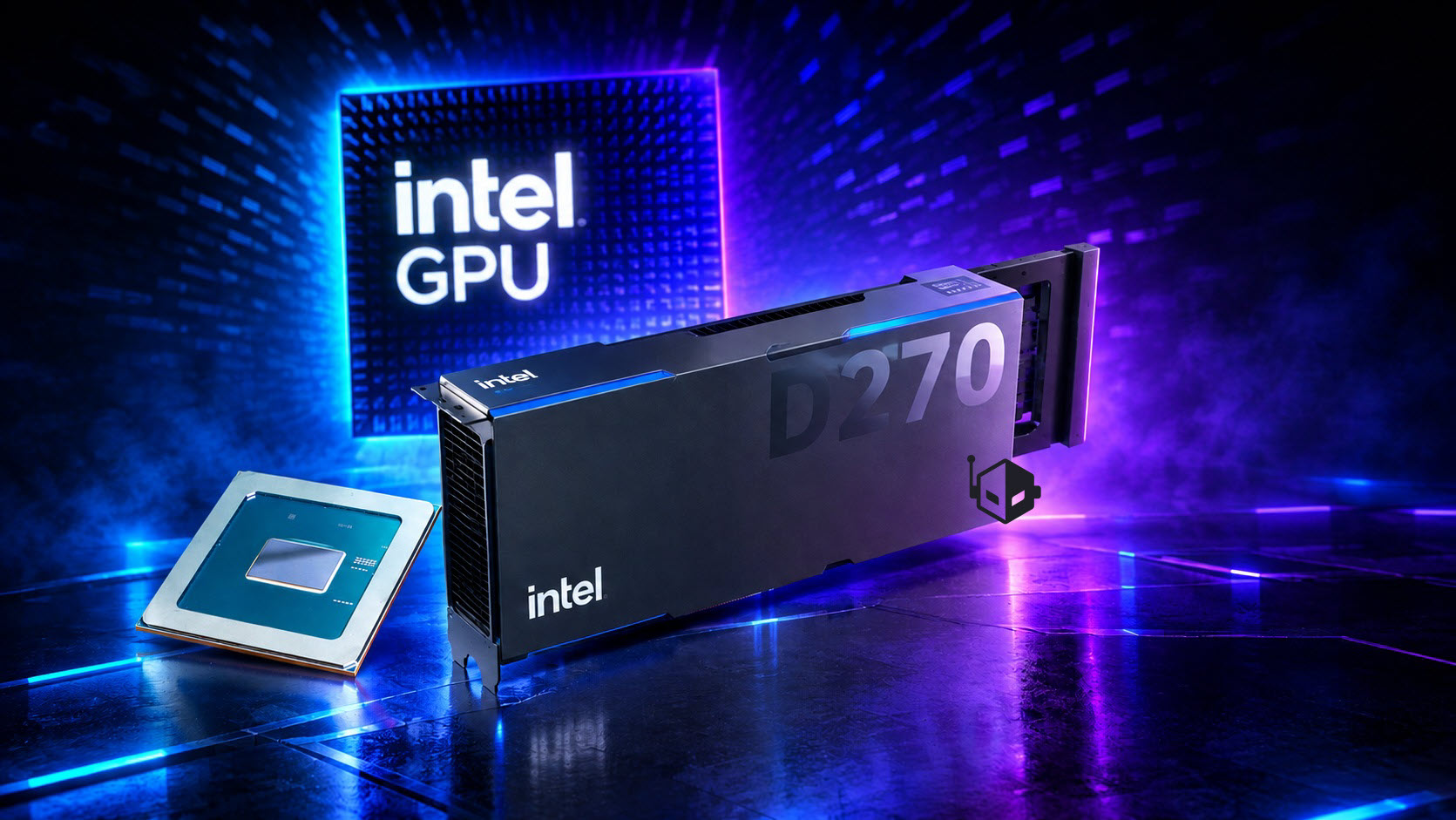
The flagship product utilizing the Xe3P architecture is the D270, an Intel reference design. Initial configurations will boast 160 GB of LPDDR5X memory, with partner configurations offering up to a massive 480 GB of LPDDR5X memory. Some advanced configurations might even feature a staggering 512 GB of VRAM, setting a new standard for memory capacity in GPUs. The memory subsystem will provide up to 1.5 TB/s of bandwidth, making it a game-changer in the AI segment.
At the Hot Chips 2026 event, Intel revealed that the Crescent Island GPUs would feature up to 32 Xe3P cores and a TDP of 350W in air-cooled designs. The reference solution is projected to deliver 1300 TFLOPs of FP8 compute capabilities, thanks to 256 next-gen XMX AI units embedded in each chip.
Innovative Design and Scalability
Intel also showcased the first images of the Crescent Island “D-Series” GPUs, featuring a dual-die layout and copper cooling plate. Based on the N3P process technology, these GPUs are compact yet powerful, leveraging AI-specific accelerators for optimal performance.
Furthermore, Intel introduced an OAM variant at OCP, highlighting a module with two D-Series GPUs, individual LPDDR5X memory sets, a PLX connector, and a Mezzanine connector. This innovative solution incorporates a large copper block with integrated liquid cooling, setting new standards for GPU design.
Future Prospects and Industry Impact
Intel’s Crescent Island GPU platform is positioned as a formidable contender in the Agentic AI space. While launch details are yet to be announced, the company’s development progress and product showcases indicate a potential rollout later this year. With a focus on AI innovation, Intel is poised to make a significant impact in the gaming and technology sectors.
In conclusion, Intel’s D-Series GPUs represent a new era of gaming graphics, combining cutting-edge technology with unparalleled performance. As the industry eagerly anticipates their official release, it’s clear that Intel is on the brink of a major breakthrough in the world of gaming and AI.