Table of Contents
While the days of games companies raising massive amounts on Kickstarter may be behind us, the platform still offers a viable way to secure funding for your game, at least in part.
Research conducted by Thomas Bidaux from Ico Partners reveals that in 2025, games companies raised $26 million on Kickstarter, matching 2024’s figures. This marks one of the more successful years since the last major Kickstarter surge in 2015.

In the previous year, 443 video game projects successfully secured funding on Kickstarter, representing a slight decrease (4%) from 2024. In 2025, 55 game projects raised over $100,000, with 11 surpassing the $500,000 mark.

“The last time we saw so many projects exceeding $500k was in 2015,” notes Bidaux. “Early indicators suggest that 2026 will continue the trend set in 2025. While Kickstarter may not fund the entire video games industry, it certainly presents promising opportunities for projects on the platform.”
David Harper, Managing Director of Skyhook Games, recently turned to Kickstarter to fund Lawn Mowing Simulator 2. He acknowledges that crowdfunding is never an easy route, citing various “background challenges” that can influence a project’s success.

“Gamers often face decision paralysis,” Harper explains. “The oversaturation of marketing channels, lack of curation, and challenging economic conditions within the games industry and beyond add to the complexity.”
One major obstacle for Kickstarter projects is the entry barrier. In the platform’s early days, companies could pitch mere ideas; for example, Frontier’s Elite: Dangerous garnered over £1.5 million on Kickstarter in 2012 despite being a work in progress. Presently, having an almost complete game is essential for funding.
“Your game must be at a stage where you can capture release-quality footage, ideally providing a demo,” Bidaux emphasizes. “Moreover, a robust marketing strategy is crucial. You should already have an engaged audience interested in the game. While the campaign can expand your reach, having a solid foundation is imperative.”
“Both these aspects mean you can’t turn to Kickstarter impulsively if funds run low or if you need the money to refine the project for presentation,” he adds.
“Crowdfunding essentially revolves around marketing and community engagement. In an industry where funding is scarce, reaching the point where Kickstarter becomes viable is no easy feat.”
Challenges with Bad Actors
Harper also encountered challenges with scammers on Kickstarter. On two occasions, the project received substantial pledges that seemed promising but were later removed, impacting the crowdfunding campaign for Lawn Mowing Simulator 2 in its final 24 hours.

“Although we had been ‘funded’ for over three weeks, a withdrawn pledge pushed us below our target at the last minute,” Harper recounts. “Fortunately, Kickstarter extended our campaign, and with additional support from backers who recognized our situation, we successfully completed the campaign. However, this situation made it challenging to feel fully in control of our destiny.”
Harper acknowledges the difficulty platforms face in managing such activities, as additional measures to deter scammers may inadvertently affect genuine backers.
“To prevent experiences like ours, one approach is to limit the cost of higher pledge tiers,” he suggests. “This prevents a single withdrawn pledge from derailing the entire campaign but also restricts the opportunity for genuine backers to offer substantial support. It’s a delicate balance between risk and reward.”
A Potentially Arduous Journey
Crowdfunding in the gaming sector isn’t without its critics. Daniel Milo, indie director at Azoove developer Timeless Toucan, advised studios on LinkedIn against relying on crowdfunding for their games.

According to Milo, a “mostly finished” game and an existing audience are almost always prerequisites for success in crowdfunding. He warns that selling keys via the campaign for a game on Steam can lead to negative consequences, as the platform may disregard reviews from the core audience. An unsuccessful campaign could also hinder efforts to secure a publisher.
“Crowdfunding faces numerous systemic issues, compelling many studios to adopt tactics that I disapprove of,” Milo elaborates. “The all-or-nothing funding model and the ‘funded in 35 seconds’ culture push studios to set targets well below what is genuinely required, risking a ‘funded’ game that may never reach completion.”
“Seek traditional funding through publishers, angels, and VCs, if you are desperate”
Milo suggests exploring alternative funding options. The first is the “traditional route.”
“If you’re in dire need, seek funding through publishers, angel investors, and venture capitalists,” he recommends. “With a high-quality game and a robust marketing campaign, you can demonstrate traction and quality to potential investors.”
Another option is a revenue-sharing or “sweat equity” approach, where team members initially accept minimal or no salary in exchange for a share in future profits or company ownership.
“By not relying solely on crowdfunding money and aligning your scope with people’s comfort levels from the start, you can mitigate risks,” Milo advises.
Prior Preparation
The key advice from experts is clear: invest significant effort in building a community before launching a crowdfunding campaign. Hrvoje Horvatek, CEO and game designer at The Red Solstice and Atre: Dominance Wars developer Ironward, suggests setting up a Kickstarter page well in advance of the campaign launch.

“Don’t launch until you have at least 500 followers,” he advises. “This ensures a strong start even if your marketing efforts fall short.”
Bidaux recommends a substantial marketing effort before the campaign launch, suggesting a minimum of three months of preparation. Some experts even advocate planning for up to six months.
Regarding followers, Harper stresses the importance of verifying the authenticity of accounts following your project.
“Don’t launch unless you reach at least 500 followers”
“While you can boost your campaign’s follower count by paying marketing agencies, you risk acquiring fake accounts or bots,” he cautions. “We opted not to use an agency for this purpose, but a campaign launched simultaneously encountered significant issues. Despite having more followers, very few converted into backers at launch, highlighting the challenges.”
Harper also emphasizes the significance of crafting a compelling campaign page.
“In addition to building your community pre-launch, allocate ample time to curate high-quality concept art, screenshots, and gameplay videos showcasing your game in the best possible light,” he advises. “You’ll also need logos, GIFs, banners, attractive graphic design, and well-crafted copy to make your campaign page stand out.”
Capture Attention
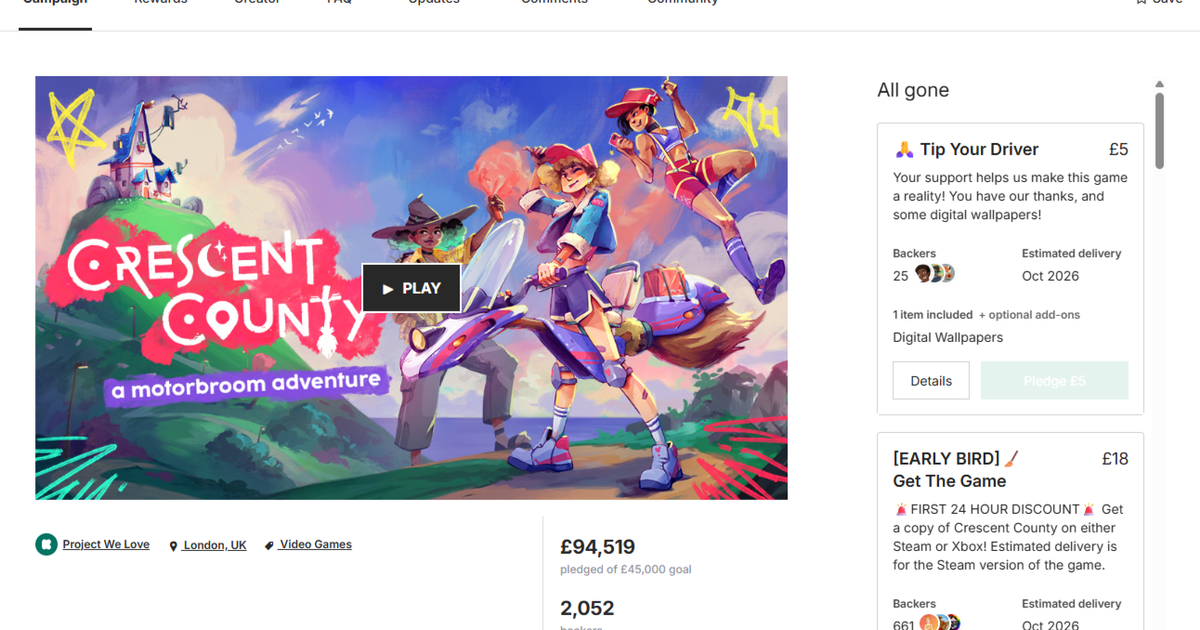
Crescent County by Electric Saint, recently acquired by Kinetic Publishing, exceeded its Kickstarter goal in 2025, raising nearly £95,000. Electric Saint co-founder Anna Hollinrake offers a valuable tip for aspiring crowdfunders: “Utilize GIFs. Fill your page with gameplay GIFs, prioritize your art, and ensure visually striking imagery. Display playable gameplay prominently.”

Hollinrake also emphasizes the importance of showcasing the game development process and offering a behind-the-scenes look to the community.
“Don’t hesitate to share working sketches and early concepts, as people appreciate seeing the evolution, especially in the age of AI,” she suggests. “Transparency and honesty about your creative process are key. Authenticity is highly valued by the Kickstarter community.”
The Electric Saint co-founder also advises understanding which parts of the Kickstarter campaign page are editable after launch.
“We overlooked adding images to individual rewards, which couldn’t be updated later,” she notes. “Once a backer claims a reward, it’s fixed. You must exercise caution, but you can always add extras later on.”
Attention to Detail
While studying successful Kickstarter campaigns is beneficial, Bidaux stresses the importance of understanding why they succeeded.

“It’s easy to make costly mistakes by merely looking at past successful campaigns without understanding what resonated with their audience,” he explains. “Neglecting to design rewards properly, for instance, has derailed numerous well-funded projects.”
Bidaux also highlights an often overlooked piece of advice: engaging in dialogue with Kickstarter itself.
“Kickstarter boasts a dedicated Games team committed to creators’ success on the platform,” he points out. “Reach out to them.”
Setting a funding goal involves a bit of dark art. If projects fall short, they receive nothing, making target setting a delicate balance.
“We had to consider the minimum development time required and the corresponding budget,” Hollinrake shares.
“We had to determine fair wages – not extravagant ones – to ensure we could piece together everything we had made to deliver a complete experience,” she adds.

Although Kickstarter may not be making headlines as it once did, the future for games on the crowdfunding platform remains promising. Bidaux sees significant untapped potential for games and crowdfunding.
“As game marketing becomes increasingly challenging, crowdfunding presents an excellent opportunity for self-funded projects with a positive ripple effect on the audience,” he notes. “I believe there are more opportunities for video game crowdfunding in the future than ever before.”
Harper echoes this sentiment, stating, “Video game crowdfunding, on the whole, is in a favorable position. While