Topic: In an Era Where Implementation is Easy, What Do We Compete With Speaker: Nexon Korea Co-CEO Kang Dae-hyun Session: Keynote
Nexon Korea Co-CEO Kang Dae-hyun revisited a question he posed on the same stage eight years ago. At the time, under the title ‘A Voyage Toward Fun,’ he cited the example of curling—a sport once considered uninteresting—which captivated the entire nation during the 2018 PyeongChang Olympics.
The rules and the weight of the stones remained the same; what changed was the ‘context.’ Teams to root for emerged, dramatic comebacks occurred, and the name ‘Yeong-mi’ became a cultural touchstone. His conclusion eight years ago was: “The essence of fun exists even outside of implementation.”
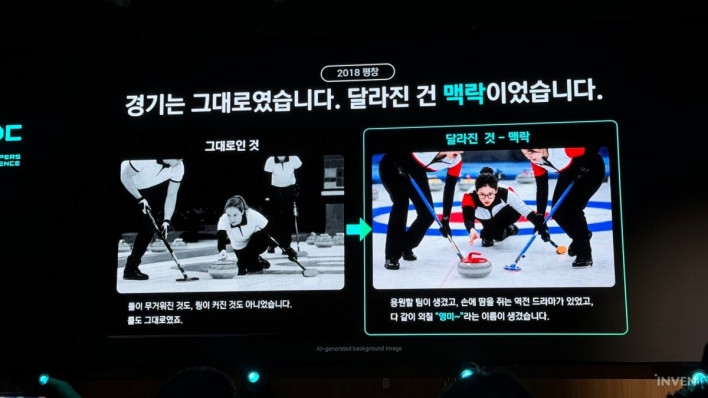
“In 2018, it was enough to discover that the essence lies outside of implementation,” Kang said. “But in 2026, the barrier of implementation itself is rapidly collapsing. The question today is: where does the essence go now.”
“This is the true capital of the AI era,” Kang stated. He emphasized the importance of context and compound interest in the world of AI. Time alone does not automatically turn context into an asset; it is the quality of experiences that elevate the next. Kang used the example of users sharing strategies and celebrating together in a game community to illustrate how context is connected to context. He highlighted the significance of understanding the context in making decisions, stating that AI can assist with analysis but ultimately, the responsibility lies with the individual who comprehends the context.
Kang compared the connection of context to compound interest, where value explodes once it reaches a certain density. He referenced soccer as an example of a world where experiences accumulate as compound interest over time. Kang believed that when a game becomes an independent world like soccer, it signifies a significant shift in its cultural impact.
He cited examples of worlds created by context such as Roblox and Minecraft, where relationships and creations intertwine to build rich virtual environments. Kang also shared personal experiences from Nexon, highlighting how users live within games and contribute to the context of the virtual worlds.
Furthermore, Kang proposed that a game is not just a printout, but a promise. He emphasized the importance of keeping promises in maintaining trust and accumulating context capital. Kang also addressed the advantage that smaller teams may have in accumulating context capital due to their agility and proximity to users. He stated, “Nexon’s 20 years of accumulated context is not just a static asset but one that diminishes in value the moment we cease to add to it.”
Kang wrapped up his presentation by discussing two types of ‘AI.’ One is the commonly known Artificial Intelligence that reduces implementation costs quickly, but also makes it challenging to stand out as it is universally available. The other type is Accumulated Intelligence, which represents the wealth of contextual knowledge gained over time— the experiences shared with users, the insights gathered through operations, and the community-driven culture established. This kind of intelligence cannot be purchased, cannot be manufactured artificially, and can only grow through the passage of time.
“The first type of AI is a tool used by all, whereas the second type belongs to those who appreciate the significance of context,” he explained. “In a time where implementation is becoming more streamlined, our strategy should involve leveraging the first type of AI effectively while enriching the second type even further.”
“The collective experiences shared with users are irreplaceable by any competitor or AI,” Kang stressed. “In addition to the off-the-shelf artificial intelligence solutions, it is crucial to develop another form of intelligence: accumulated intelligence.”
“While there are countless AI-generated products in the world, a product that holds meaning within your game, one that brings a smile to users’ faces upon sight, can only be crafted by you,” he noted. “What truly matters is not where you start, but rather the decision to begin accumulating today.”
Reflecting on his past appearance on stage where he shared a personal story about curling eight years ago, he concluded the keynote by stating, “Even if the game itself remains constant, the context we create shapes a world. The moment your game evolves into such a world for someone will stem from the effort you put into accumulating today.” Could you please rewrite the following text?