Table of Contents
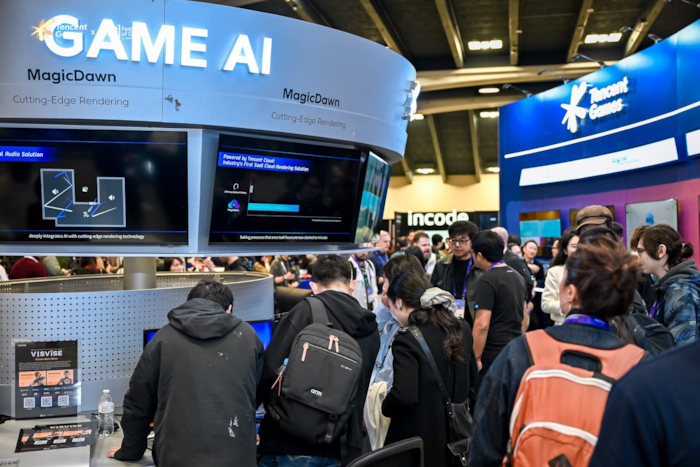
During the Game Developers Conference 2026 (GDC 2026), Tencent unveiled its trio of core AI solutions: ‘MagicDawn,’ ‘VISVISE,’ and ‘ACE.’
Tencent highlighted a significant evolution in its AI technology at this year’s event, emphasizing the shift from using standalone tools to integrating AI throughout the production process.
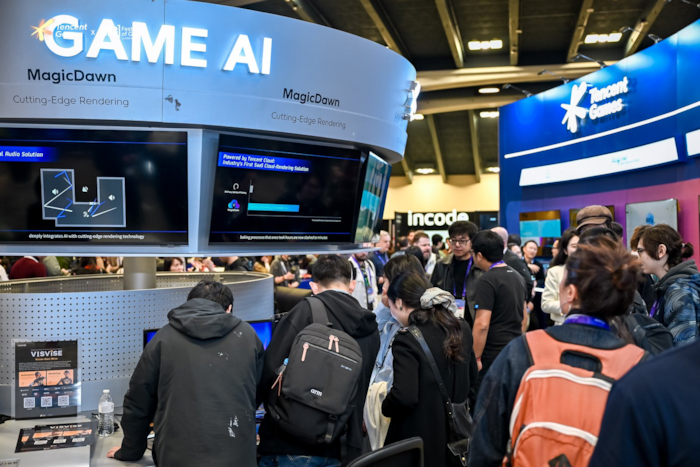
Beyond basic image and code generation, Tencent’s focus was on delivering stable, high-quality outputs that meet complex game industry standards. Through live demonstrations, Tencent underscored AI’s role in fundamentally enhancing game development productivity.
‘VISVISE’ streamlines the process from skeletal rigging to animation creation, giving artists more time for creativity. ‘MagicDawn’ overcomes mobile computing limitations to provide high-quality global illumination across platforms, while ‘ACE’ enhances real-time decision-making in competitive environments to establish new security benchmarks.
This demonstrated that AI is no longer just a theoretical concept but a technology deeply ingrained in all planning, development, and operational phases.
Tencent sees AI as a transformative force surpassing the impact of mobile internet. The core belief is that AI enhances efficiency, enabling full realization of human creativity. By automating repetitive tasks, developers can focus on the final stages of artistic refinement and creative breakthroughs.
To achieve this vision, Tencent has implemented a horizontal innovation mechanism for resource allocation, allowing young talent to propose and validate AI exploration projects with access to GPU computing power and data. Additionally, the company has enhanced organizational collaboration through its Middle Platform, focusing on building foundation models and managing internal data circulation to accelerate new project deployment.
For effective risk management, Tencent strictly adheres to closed data loop principles and human-machine collaboration. To ensure consistent quality, the company uses its own high-quality 3D assets for training rather than relying on public data. AI-generated outputs are considered initial drafts, editable for human refinement and fine-tuning. To address copyright and ethical concerns, Tencent complies with all relevant laws and regulations, employing advanced internal data refinement and auditing systems.
Tencent anticipates that these deep-tech innovations will significantly enhance the end-user experience. ‘VISVISE’ expands content scale, enabling richer interactions with NPCs and more personalized experiences for players. ‘MagicDawn’ brings PC-level dynamic lighting and spatial audio to mobile devices, bridging visual gaps between different platforms. ‘ACE’ ensures fair gameplay in competitive environments.
Tencent stated that as AI-native gameplay becomes fully realized, players will encounter a continuously evolving open world. The long-term objective is to establish a technology infrastructure covering the entire game lifecycle. By offering its AI capabilities as foundational infrastructure for the global gaming ecosystem, Tencent aims to lead in standardizing high-quality production tools and supporting industry advancement.
The following are insights from a Q&A session with Tencent’s core development team regarding each solution.
MagicDawn: Pushing the Boundaries of Rendering Innovation

How does technologies like cloud rendering and AI-based neural-rendering dynamic GI overcome hardware limitations to deliver top-notch visuals?
‘MagicDawn’ tackles rendering constraints arising from hardware differences through distributed cloud baking and AI neural rendering. By leveraging cloud-based GPU clusters, it achieves baking efficiency significantly higher than conventional methods, reducing tasks from hours to minutes.
During gameplay, devices only need to load pre-baked lighting data, eliminating the need for complex real-time calculations. Additionally, MagicDawn utilizes AI compression to control package size efficiently while maintaining data precision, ensuring consistent cinematic-quality lighting effects across all devices.
What visual and performance enhancements does MagicDawn bring?
Based on Unity engine scenes, MagicDawn’s lighting baking solution significantly boosts rendering frame rates while maintaining lower computational overhead and stable frame rates during map loading and transitions.
Moreover, MagicDawn’s visual enhancement tools address common visual artifacts found in traditional workflows, optimizing lighting precision and texture quality for more stable and higher-quality visuals.
Can MagicDawn be seamlessly integrated into live-service games without workflow alterations?
MagicDawn has been successfully implemented in upcoming and live-service titles like Honor of Kings: World, Wuthering Waves, and Roco Kingdom: World, showcasing compatibility with existing workflows as a core design objective.
Tencent developed a standardized cross-engine toolchain seamlessly integrating with Unity and Unreal Engine, allowing instant activation of high-quality lighting features without restructuring pipelines. For live-service games, MagicDawn supports low-impact upgrades to ensure business continuity.
What sets MagicDawn apart from native engine features in commercial engines?
MagicDawn excels in highly efficient cloud baking, leveraging cloud computing to boost efficiency, avoid crashes, and accelerate project iterations. Its high-quality dynamic lighting supports dynamic scenes, preventing light leaks and optimizing visual quality.
AI-driven package optimization controls package size for data precision, overcoming native engine limitations. Its automated toolchain covering lighting and audio streamlines processes, allowing teams to focus on creativity.
How does MagicDawn’s spatial audio solution save creative teams time?
MagicDawn automates the arduous process of generating acoustic probes and configuring materials for large open worlds, freeing up time for sound designers to focus on core creative tasks like sound design and atmosphere building.
ACE (Anti-Cheat Expert): Enhancing Game Security
Have AI advancements improved cheat detection and identified illicit users?
AI integration has significantly enhanced cheat detection accuracy in genres like MOBAs, improving the identification of abnormal behaviors. ACE’s economic security control solution can more precisely identify illicit account activity and trading networks, penalizing millions of gold-farming accounts.
In collaboration with Microsoft, ACE utilizes CPU virtualization to counter DMA hardware cheating, ensuring fair gameplay. Additionally, ACE’s multidimensional security system provides comprehensive protection against cheats through various layers of defense.
How does ACE differentiate itself from competitors in providing security?
ACE’s multidimensional security system offers a comprehensive approach to cheat analysis and defense, incorporating industry-leading client hardening to prevent cheat creation. It covers various aspects of anti-cheat measures, including samples, functions, behaviors, replays, and image/video analysis.
Unlike competitors relying on client-side blocking or sample-signature matching, ACE’s technical edge lies in years of data, security technology, and operational experience, ensuring robust protection against cheats.
How does ACE distinguish between mobile bot farming and legitimate players using machine learning?
ACE’s four-stage machine learning closed loop ensures precise differentiation between human players and bots, using confirmed cheat samples for training data. It analyzes touch trajectories and behavior patterns to separate machine commands from human input.
By cross-checking user behavior profiles and applying a feedback mechanism, ACE minimizes false positives, providing accurate cheat detection without penalizing legitimate players.
What are the main cheat methods today and how does ACE combat them?
ACE counters the threat of DMA hardware cheating by partnering with Microsoft for CPU virtualization. It introduces pre-boot mode to intercept violating processes early and leverages replay behavior analysis to halt cheating in live matches, protecting fair players.
ACE also collaborates with law enforcement to combat cheat-production groups, aiding in solving cases and arrests, contributing to a clean gaming environment.
Can you share a case where ACE’s iOS hardening solution protected revenue by blocking cracked versions?
Implementing the iOS hardening solution significantly reduced the number of cracked versions detected daily for a prominent game publisher in China. Cheat sellers even acknowledged the increased difficulty in cracking, showcasing the solution’s effectiveness in protecting revenue streams.
The solution’s adoption across Tencent’s games has proven successful, maintaining virtually impenetrable protection against breaches, benefiting both external customers and internal game titles.
How does ACE utilize its extensive cheat sample database for real-time anti-cheat actions?
ACE’s vast sample data plays a crucial role at three layers: foundational response, advanced customized response, and threat intelligence. It uses feature data for detection models, formulates game-specific defense strategies, and monitors global cheat trends to swiftly deploy countermeasures.
What ensures seamless client and server-side integration without performance degradation?
ACE’s design prioritizes extreme performance efficiency, utilizing page-skipping encryption to balance security and performance. Its zero-coupling architecture is independent of game engines, supporting various commercial engines without issues, ensuring stable gameplay even in challenging network conditions.
With a dedicated compatibility lab and robust disaster recovery mechanisms, ACE maintains high performance without compromising game integrity.
VISVISE: Empowering Game Developers with Creativity

& Yu Xiang Yang, VISVISE Product Manager, AI Engine Department, Tencent Games
How does VISVISE address players’ negative sentiments toward AI-generated content?
To combat negative perceptions, VISVISE focuses on enhancing output quality rather than mass-producing lower-grade content. By automating repetitive tasks, VISVISE allows artists to concentrate on refining details and designing unique elements, resulting in more vivid and higher-quality player experiences.
What efficiency gains has VISVISE brought, and how has it impacted development timelines?
VISVISE significantly boosts pipeline efficiency, reducing tasks from days to hours. Tasks like auto-skinning and animation generation are expedited, allowing for more content-iteration cycles and faster overall development.
The increased efficiency enables developers to invest time in diverse character and environment designs, quality polishing, gameplay innovation, and forward-looking research and development.
How does VISVISE’s frame interpolation technology maintain fidelity and natural motion in complex scenes?
The MIB model combines motion representations with an autoregressive framework to understand physical transitions between movements, ensuring smooth and realistic animations even in complex scenarios like combat or dancing.
What sets VISVISE apart in 3D motion capture, even in obscured video segments?
VISVISE’s generative model analyzes contextual information before and after occluded segments to predict plausible motion continuations, generating coherent motion even in overlapping or obscured scenarios, maintaining smooth and consistent animations.
How has one-click AI skinning and rigging reduced post-processing burden for complex clothing?
VISVISE automates over 90% of standard humanoid and clothing rigging tasks, significantly reducing manual labor. Complex clothing processing time has been reduced from days to hours, allowing artists to focus on refining results rather than starting from scratch.
What can we expect from VISVISE’s future roadmap and AI capabilities?
VISVISE’s roadmap focuses on integrating AI-generated content seamlessly into production pipelines, prioritizing real production needs over technical buzzwords. By continually improving production-oriented processes and AI agent capabilities, VISVISE aims to enhance workflows for increased efficiency and accessibility.