Table of Contents
Exploring Intel’s Next-Gen Crescent Island PCIe Graphics Card
Intel’s upcoming Crescent Island PCIe graphics card has been unveiled through a leaked PCB image, offering a glimpse into the powerful Xe3P GPU and its support for LPDDR5X memory.
The First Look at Crescent Island “Inference” AI Accelerator
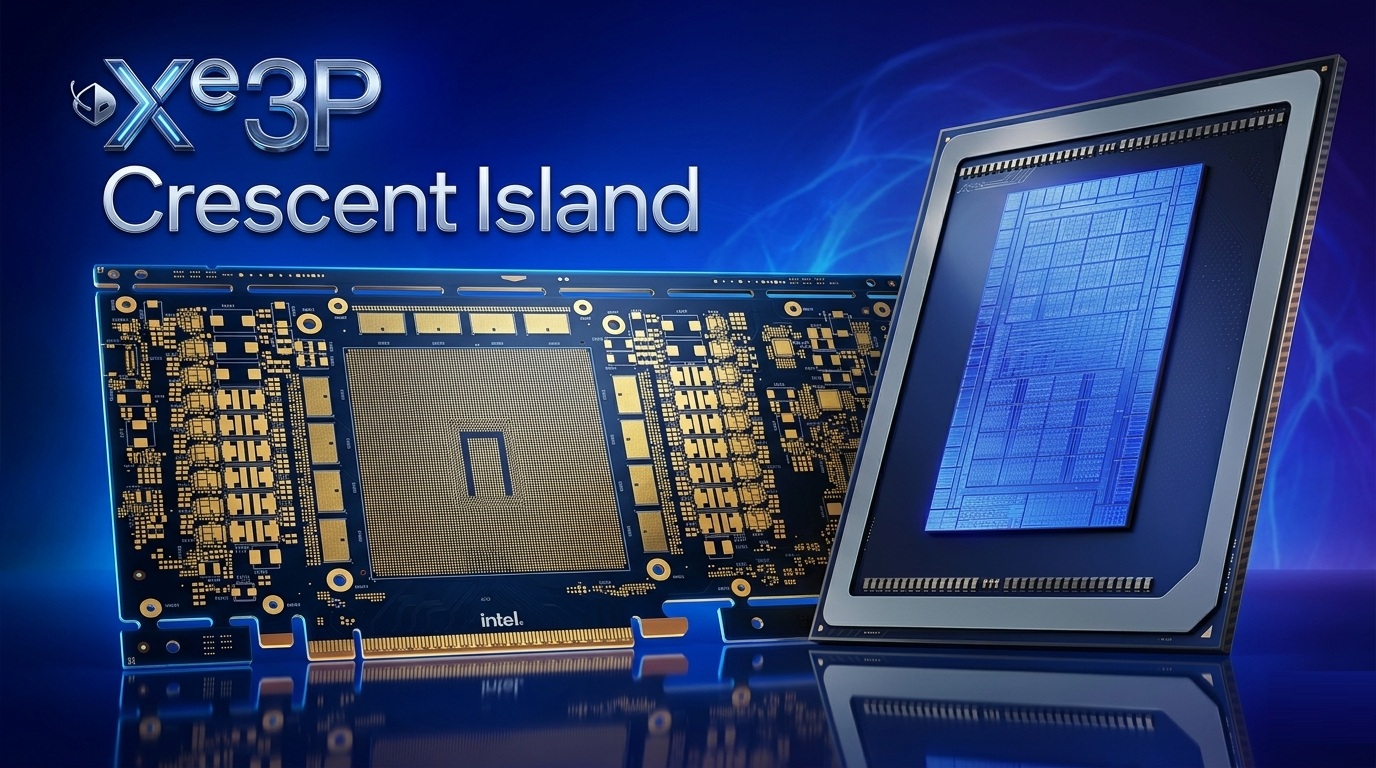
The leaked images of the Crescent Island PCIe accelerator’s PCB, shared by YuuKi_AnS, reveal Intel’s latest AI inference accelerator designed to provide exceptional value in AI workflows.
The large Xe3P GPU on the Crescent Island PCB showcases the impressive scale of Intel’s design, surpassing the current Xe2-based BMG-G31 flagship GPU. The card features 20 LPDDR5X memory slots, offering a total capacity of up to 160 GB.
Key Features of Intel’s Crescent Island GPUs
The Crescent Island GPU is built on the cutting-edge Xe3P architecture, set to power Intel’s next-gen Arc C-Series. This architecture promises improved scalability for a wide range of applications, from client iGPUs to data center AI GPUs.
The new data center GPU code-named Crescent Island is being designed to be power and cost-optimized for air-cooled enterprise servers and to incorporate large amounts of memory capacity and bandwidth, optimized for inference workflows. Key features include:
- Xe3P microarchitecture with optimized performance-per-watt
- 160GB of LPDDR5X memory
- Support for a broad range of data types, ideal for “tokens-as-a-service” providers and inference use cases
Intel’s focus on power and cost optimization with the Xe3P architecture aims to cater to AI inference workloads in air-cooled data center environments. The use of LPDDR5X memory sets the Crescent Island GPU apart from competitors, offering a cost-effective solution with extensive memory capacity.
Future Prospects for Intel’s Crescent Island GPUs
As Intel prepares for the launch of the Crescent Island GPU in the second half of 2026, the company’s commitment to open and unified software stack for heterogeneous AI systems positions the GPU as a versatile and powerful solution for various industries. Stay tuned for more updates on this innovative graphics card!


About the author: A Software Engineer by training and a PC enthusiast by passion, Hassan Mujtaba serves as Wccftech’s Senior Editor for hardware section. With years of experience in the industry, he specializes in deep-dive technical analysis of next-generation CPU and GPU architectures, motherboards, and cooling solutions. His work involves not only breaking news on upcoming technologies but also extensive hands-on reviews and benchmarking.
Follow Wccftech on Google to get more of our news coverage in your feeds.