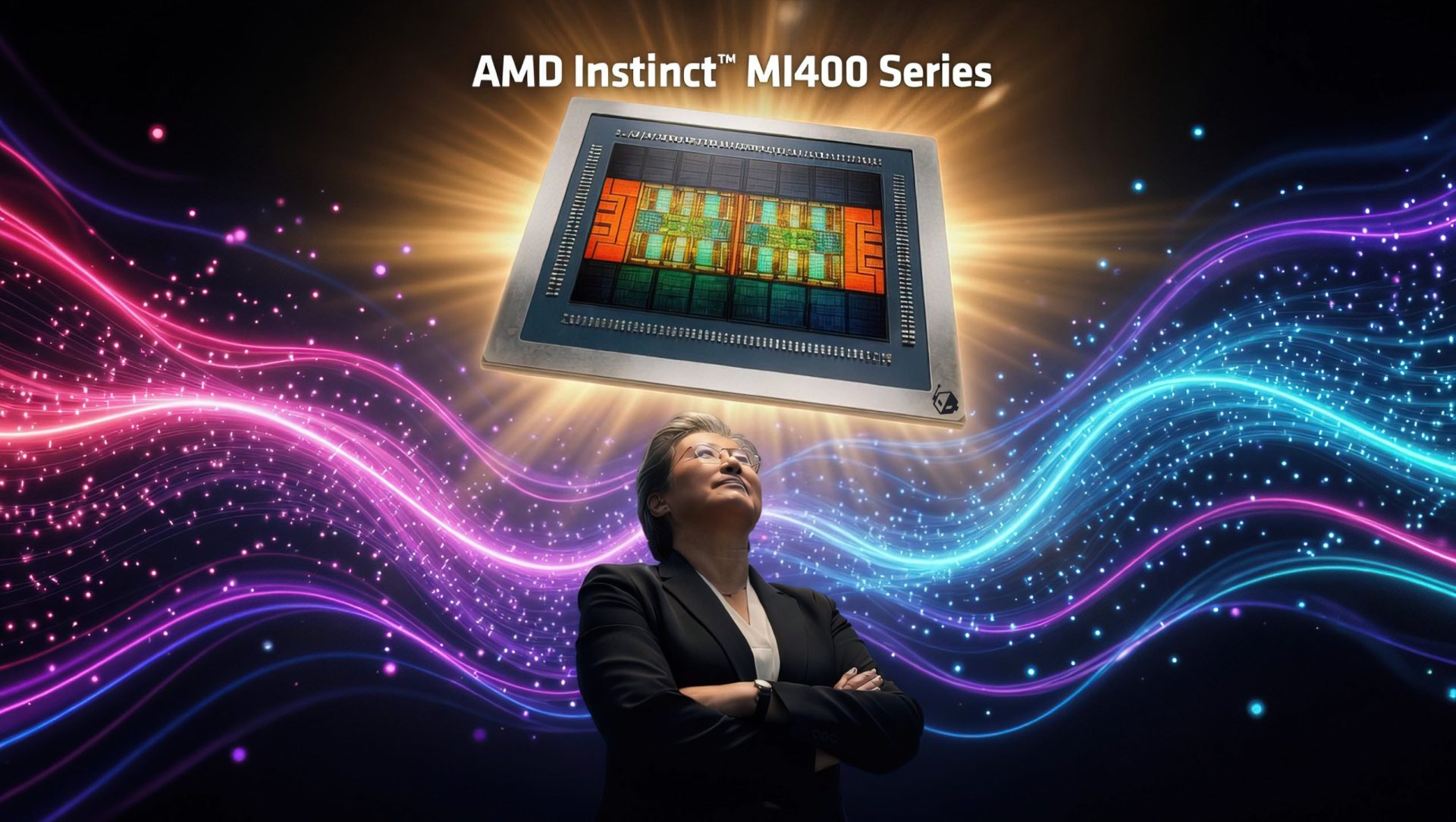
Rumors are swirling about AMD securing a significant AI customer deal with its upcoming Instinct MI450 GPU accelerators.
Supply Constraints Lead Anthropic To Partner With AMD, Utilizing Next-Gen Instinct MI450 GPUs
Due to supply chain constraints in the industry, major AI players are seeking infrastructure solutions from various companies.
AMD is seizing this opportunity and has hinted at multiple “Open-AI” scale customers lined up for its existing and upcoming Instinct AI accelerators. The company already has OpenAI & META on board, with the latter committing to 6 Gigawatts, including multiple generations of Instinct accelerators.
Now, AMD is aiming for another significant AI customer win, this time with Anthropic. Reports suggest that the AI firm intends to integrate the next-gen Instinct MI450 accelerators into its servers, pushing capabilities to new levels.
This year, AMD will introduce its Instinct MI400 series AI accelerators in MI450X and MI430X variants. The new lineup will be based on the CDNA 5 architecture and will offer:
- Increased HBM4 Capacity & Bandwidth
- Expanded AI Formats with Higher Throughput
- Standard-Based Rack-Scale Networking (UALoE, UAL, UEC)
The official specifications list the MI400 as a 40 PFLOP (FP4) & 20 PFLOP (FP8) product, doubling the compute capability of the MI350 series, a popular product for AI data centers.

In addition to the compute capability, AMD will utilize HBM4 memory for its Instinct MI400 series. The new chip will offer a 50% memory capacity increase from 288GB HBM3e to 432GB HBM4. The HBM4 standard will provide a significant 19.6 TB/s bandwidth, more than double that of the 8 TB/s for the MI350 series. The GPU will also feature a 300 GB/s scale-out bandwidth per GPU, indicating major advancements in the next generation of Instinct.

AMD has positioned its Instinct MI400 GPUs against NVIDIA’s Vera Rubin, with the high-level comparison outlined below:
- 1.5x Memory Capacity vs Competition
- Same Memory Bandwidth vs Competition
- Same FP4 / FP8 FLOPs vs Competition
- Same Scale-Up Bandwidth vs Competition
- 1.5x Scale-Out Bandwidth vs Competition
If the rumored deal with Anthropic materializes, it would signify a significant win for AMD and another boost for the Helios AI racks. This development underscores the current constraints in the semiconductor industry. Notably, this news coincides with Anthropic’s strategic alliance with Google and Broadcom.
Anthropic now has access to multiple AI solutions, utilizing NVIDIA’s GPUs, Amazon Trainum, and with the new Broadcom/Google partnership, gaining access to TPUs as well. Furthermore, partnering closely with Broadcom, experienced in ASICs, could potentially lead Anthropic to venture into custom silicon for its Claude models in the future.
We have signed a new agreement with Google and Broadcom for multiple gigawatts of next-generation TPU capacity that we expect to come online starting in 2027. This significant expansion of our compute infrastructure will power our frontier Claude models and help us serve extraordinary demand from customers worldwide.
via Anthropic
Meanwhile, AMD has demonstrated its pivotal role in the AI industry and the suitability of its products for rack-scale AI ecosystems.


Today, AMD and representatives of the French government announced plans to deepen collaboration in support of France’s National Strategy for AI, aimed at accelerating local AI innovation, expanding access to open and advanced compute resources for the local AI ecosystem and strengthening France’s position in the global AI landscape.
Furthermore, AMD has collaborated with the French Government to support the country’s growing AI needs, including the Alice Recoque, France’s first exascale supercomputer. This collaboration will empower France’s AI community with AMD’s high-performance computing platforms and open software ecosystem.

About the author: A Software Engineer by training and a PC enthusiast by passion, Hassan Mujtaba serves as Wccftech’s Senior Editor for hardware section. With years of experience in the industry, he specializes in deep-dive technical analysis of next-generation CPU and GPU architectures, motherboards, and cooling solutions. His work involves not only breaking news on upcoming technologies but also extensive hands-on reviews and benchmarking.
Follow Wccftech on Google to get more of our news coverage in your feeds.