‘The Coma 3,’ the title that will put a period on the 11-year-long The Coma series, is set for official release on April 30.
Launched in October 2015 with ‘The Coma: Cutting Class,’ The Coma series has consistently received acclaim from genre fans for its polished visuals, intricate storytelling, and authentic ‘run-and-hide’ survival horror mechanics. Subsequent titles, including ‘The Coma 2’ and the spin-off ‘The Coma 2B,’ followed suit, building on the stories of their predecessors while continuously evolving their visuals and systems to become the signature series for Devespresso Games.
Now, The Coma series returns with ‘The Coma 3’ to finally conclude the story that has been unfolding all these years. With visuals and systems more advanced than ever and the long-awaited resolution to the narrative, the fandom’s excitement is at an all-time high.
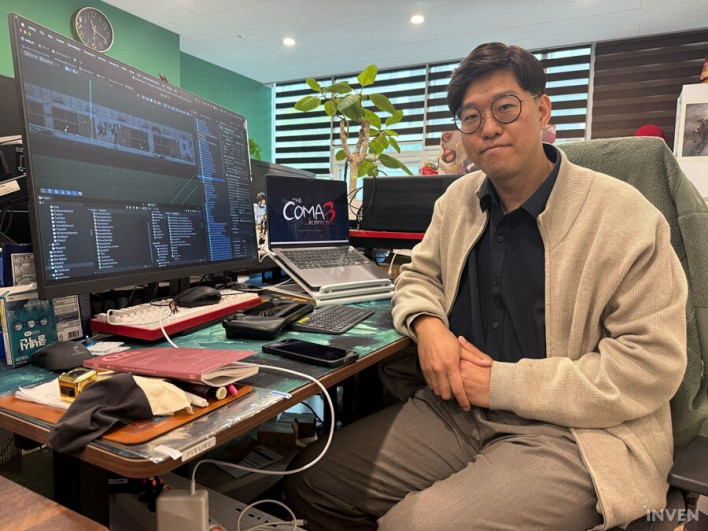
These 11 years have also been the years of youth for Devespresso Games CEO Kim Min-ho. What does it mean for him to bring The Coma series to a close? And where is his gaze directed now that the journey is nearing its end? Ahead of the official release, we visited Devespresso Games to hear his reflections and thoughts on the future.
▲ Devespresso Games CEO Kim Min-ho
Putting a Period on the 11-Year Journey of The Coma Series
‘The Coma 3,’ the grand finale of The Coma series, is about to be released. How are you feeling.
“Since I incorporated the company while developing ‘The Coma: Cutting Class,’ I have effectively spent 11 years with The Coma series. Looking around, there are very few small indie studios that have managed to sustain development for this long unless they had a massive ‘hit.’ In that sense, I feel a sense of relief, but mostly, I am just filled with gratitude.
Honestly, in the beginning, I was a bit arrogant (laughs). When ‘The Coma: Cutting Class’ was released and received good reviews, I sometimes thought, ‘I worked hard, so I got good results,’ especially since it was my first game and I had poured my soul into it.
But as time passed, I began to see things I had missed. I realized that we were able to make it this far not just because of my own effort and time, but because of the support from those around me and the interest and love from the people who bought the game. That is why I am just grateful now. I believe it is a miracle that we made it this far, thanks to the help and interest of so many people.
On the other hand, I also feel a sense of relief that we have finally put a period on the 11-year series. To be honest, I have always felt a kind of ‘debt’ regarding the story. As the world expanded with each sequel, there were many unresolved plot points. Writing and developing ‘The Coma 3’ required a lot of work to re-establish settings and tie up loose ends. I feel lighthearted now that all of that has finally been resolved. I was also worried that players might interpret the story differently than intended or find it too complex, but after talking to our testers, they generally felt the narrative flowed cleanly, which is a huge relief.
You have concluded The Coma series after 11 years. What would you say to yourself?
“I would say, ‘You survived well so far. But don’t let your guard down, as there is still more to learn.’ When I finished developing ‘The Coma 3,’ I felt proud, thinking, ‘Finally, it’s all over!’ But then, the friend who manages the company told me, ‘This isn’t the time to take a breather; we need to improve these things next time.’ He was already looking at the next step, and strangely, I didn’t feel frustrated at all (laughs). Instead, I thought, ‘Right, you’re right. There’s no time to be complacent. We need to show something even better next time.’ I will continue to work hard and evolve so that we don’t fall behind.
It couldn’t have been easy to develop games as a small studio for 11 years. What was the driving force that kept you from giving up.
“Rather than one massive driving force, I think it was the satisfaction of being able to do the work I wanted to do. That doesn’t mean it was always fun. There were times when I was happy, but there were also many times when I was under immense stress. I would lose sleep at night, and people around me would ask, ‘Why do you insist on doing this if it stresses you out so much? Isn’t it hard?’ But even considering all that, I loved this work. I love creating stories, and the fact that I could turn the stories I conceived into games—that, in the end, was the biggest driving force.
Someone once said that while building a world and continuing a story is hard, finishing it is even harder. ‘The Coma 3’ must have been the same; did you experience the ‘pain of creation’.
“I think there were more moments of joy than pain. For example, when planning the story for The Coma series, I always kept the sequels in mind. While the main story was completed in each game, I left breadcrumbs to create room for sequels and strengthen the connections. Perhaps that’s why, whenever I developed a sequel, I would look back at the previous game’s story and think, ‘Oh, I can resolve this plot point like this—wow, I’m a genius!’ (laughs).
Due to my deep love for conceptualizing stories, I never experienced the ‘pain of creation.’ However, the pressure of concluding the series was definitely felt. The uncertainty of whether the ending would be well-received by the audience was a constant source of anxiety. Different individuals have varying standards for judgment and understanding, making it challenging to ensure that the resolution of plot points and foreshadowing would provide the desired catharsis or dopamine for the players. Fortunately, the feedback from our testers has been positive, which is a relief.
While the focus was primarily on the story, the process of translating it into a game presented its own set of challenges. It was enjoyable to tie up loose ends, add depth, and connect the narrative to previous entries, but adapting these elements into gameplay mechanics was a different endeavor altogether.
Song Tze-hyun has been introduced as a new playable character. This decision seems unconventional given her previous roles in the games. Can you shed light on why she was chosen over other potential candidates?
“Song Tze-hyun possesses a unique allure as a character. While she may have served as a supporting character in the real world, a menacing figure resembling her emerged as a primary antagonist in the Sehwa Mirror World. Despite her limited screen time, players have always perceived her as a central character. Additionally, Tze-hyun’s real-world appearance exudes beauty, further solidifying her status in the eyes of the players.
There has been a consistent demand from the audience across different installments for Song Tze-hyun to become a playable character. As we planned to implement a three-protagonist system in ‘The Coma 3,’ it seemed fitting to fulfill this request. While other candidates such as Ye-sol and Su-mi were considered, Ye-sol’s strength would have shifted the game towards action rather than survival horror. Su-mi, on the other hand, belonged more to the past and introducing her as a protagonist would have skewed the narrative towards a prequel. We needed a character unfamiliar with the Mirror World to provide a fresh perspective, and Song Tze-hyun emerged as the ideal choice.
Having three playable characters in the game has been met with both appreciation and concerns about potential clutter. How do you address these opinions, especially those highlighted in the demo feedback?
“The decision to incorporate a three-protagonist system was driven by our desire to enhance player immersion by showcasing diverse character attitudes towards the Mirror World. In the horror genre, fear tends to diminish as familiarity with the environment grows. By introducing characters with varying levels of experience and vulnerability, we aimed to maintain a sense of tension and engagement throughout the gameplay.
While initial impressions from the demo may have hinted at disjointed gameplay due to the separate character narratives, it is essential to recognize that the protagonists eventually converge and unite as the story unfolds. As the players progress through the game, the perceived clutter or fragmentation is expected to dissipate, paving the way for a cohesive and engaging gameplay experience.
Will ‘The Coma 3’ serve as the definitive conclusion to all lingering questions and mysteries within the narrative? Additionally, are there any plans for spin-offs, DLC, or sequels following the release of the game?
“The narrative arc centered around Sehwa High School will reach its culmination with ‘The Coma 3,’ thereby ruling out any spin-offs, DLCs, or direct sequels like ‘The Coma 4’ within the same storyline. This decision aligns with the organic progression of the story and ensures a fitting closure to the characters and events associated with Sehwa High.
However, this conclusion does not mark the end of The Coma series as a whole. There remains ample potential to explore and expand the Coma universe in new directions. In the event of a future installment in The Coma series, it is likely to feature fresh characters in a distinct setting, offering a renewed perspective and narrative exploration.
What lies ahead for Devespresso Games post-The Coma?
Reflecting on your 11 years of game development, is there a particular moment that stands out as the most memorable for you?
“When reminiscing about the journey, it is the challenging moments that seem to linger most vividly. There were no standout ‘glorious’ instances that come to mind. Personally, I consider that perspective to be a luxury (chuckles). Our endurance through those arduous times has been instrumental in bringing us to where we are today.
Despite the hardships, I do not harbor regrets or resentment towards those difficulties. They have been integral to our growth and resilience as a team. The process has been a mix of joy in creating games and the weight of responsibility that comes with overseeing a company as its CEO. This blend of emotions is something I believe resonates with many indie and small studio developers, as it is an inherent part of our journey.
Observing Devespresso Games’ portfolio, it is notable that, aside from ‘The Last Spell,’ the titles are predominantly PC-based.
Small studios typically prefer to release their games on mobile platforms. Is there a specific reason for this choice?
“There are two main reasons for this preference. Firstly, mobile game development is actually riskier than it may seem. While there is a common perception that mobile games have higher sales due to their accessibility, the reality is quite different. It is more challenging to reach users on mobile platforms, as getting featured in app stores is difficult, and users tend to stick to games that are already popular rather than trying out new ones. Additionally, certain genres that were once dominated by indie developers have now been taken over by larger corporations.
Secondly, the type of games that small studios like ours want to create may not align well with the mobile platform. For example, our game series The Coma is a story-driven survival horror adventure, which may not be the best fit for mobile gaming. We believe that our strengths lie in developing games for PC, and we have focused on that platform so far as it aligns better with our game development goals. In a way, this strategy has been our key to survival in the industry.” All translations supported by AI undergo a thorough review and refinement process by our newsroom team.