Table of Contents
The kickoff of the 2026 PUBG Esports season in Seoul, PGS Circuit 1, brought about a significant change in traditional tournament formats. Running from March 18 to April 5, the circuit combined three consecutive PUBG Global Series (PGS 1, PGS 2, and PGS 3) events into a seamless competitive structure featuring 24 teams from six regions. This shift in approach decentralized the viewing experience and led to a notable increase in viewer engagement. Three key elements drove this growth: localized production independence, the introduction of individual player streams, and a revamped competitive schedule that amplified the intensity and significance of live matches.
Elevating Engagement in PGS Circuit 1
The inaugural phase of the 2026 PUBG Esports season immediately saw a rise in audience involvement and set a benchmark for the new circuit format. Average concurrent viewership increased by 20.2% compared to the 2025 average, with total consumption reaching 5.89 million Hours Watched, a 23.7% surge.
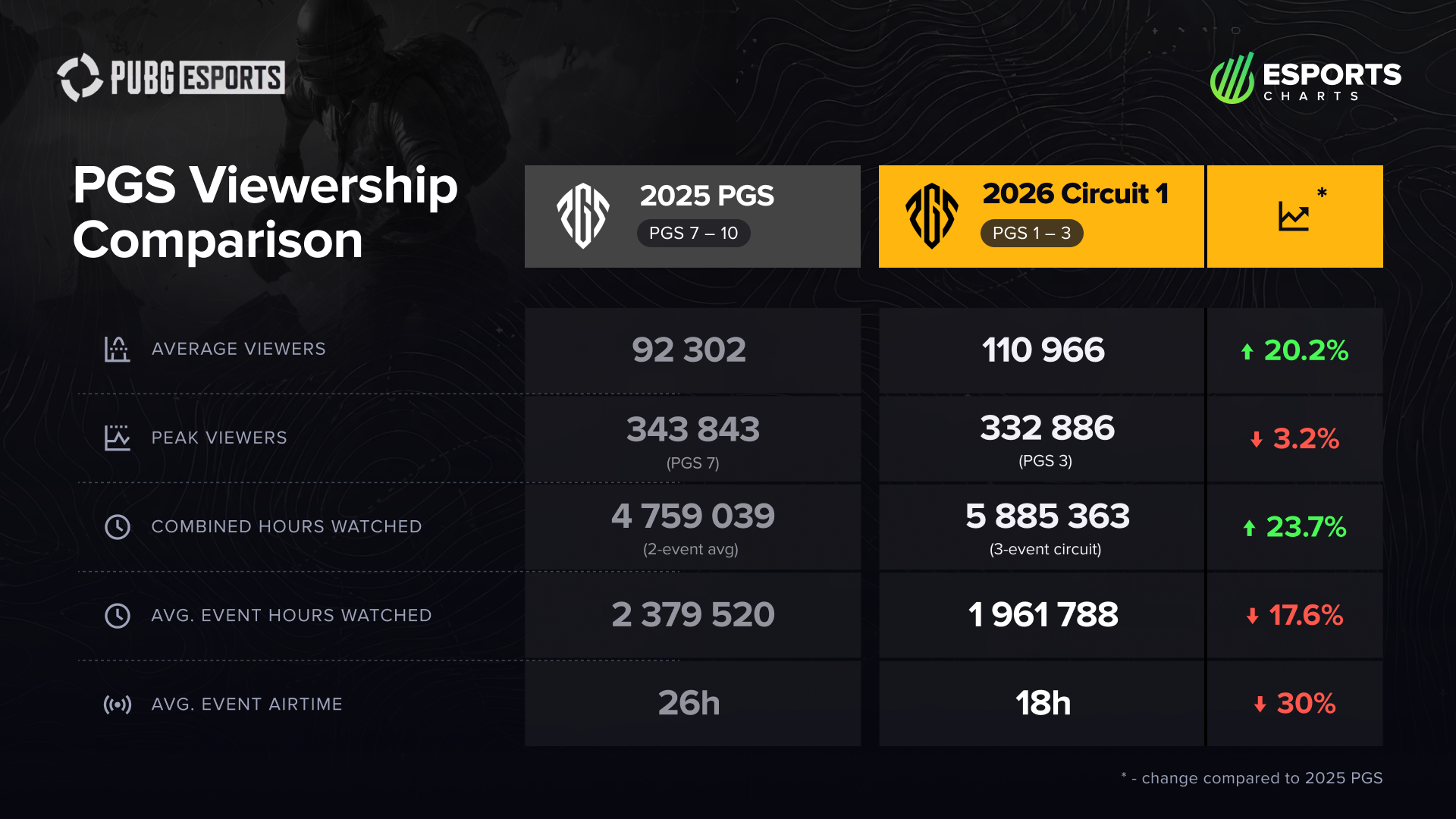
Despite a 30% reduction in airtime per event, the increased viewer concentration indicates a more engaged audience compared to previous years. The alterations in broadcast delivery and tournament structure for 2026 successfully reshaped viewer interaction with the competition, driven by the following operational and structural pillars.
Revolutionizing PUBG Esports Broadcast
The foundation of the engagement boost lies in a complete decentralization of the viewing experience. Previously, PUBG Esports depended on a single global feed produced by one team at the venue, limiting regional broadcast partners to adding commentary over pre-selected footage, often leaving fans dissatisfied when their local teams were not in focus.
In Circuit 1, this model was replaced by eight distinct regional broadcast teams, each granted full autonomy over their in-game cameras. These teams now control their own replays and narratives, ensuring that the visual storytelling is tailored to the regional audience. This change guarantees more exposure for organizations and players in their home markets.
This move towards personalization extended to the individual level with the introduction of live point-of-view (POV) streams for each competing player. With up to 64 players in a single match, the main broadcast cannot capture every moment. Individual POV streams enable fans to follow a specific player throughout the match, effectively doubling the number of active broadcast channels from approximately 100 in early 2025 to 192 during Circuit 1.
The impact of this detailed access is evident in individual channel statistics: Player “Himass” generated nearly equivalent watch time as the official Korean broadcast channel. Converting players into live content channels created a new level of viewer immersion bridging the gap between official broadcasts and creator-driven content.
Financial Incentives in PUBG Esports: Promoting Consistency
The increased match frequency and interconnected stages of the circuit model led to a shift in how teams were financially recognized. The total prize pool for Circuit 1 amounted to $500,000, with the three-event structure offering more opportunities for teams to earn payouts.

This model prioritizes consistent performance over individual tournament victories. By providing three separate events within a single competitive period, the circuit promoted a fairer distribution of prize money. Six teams earned over $30,000 during Circuit 1, a rise from previous years where only two to four teams typically reached that threshold. The share of the prize pool claimed by the top five teams also decreased to 58%, spreading earnings across a larger portion of the field.
The financial sustainability of this model is evident in the progress of teams like Petrichor Road and Natus Vincere. Despite not securing first-place finishes in every event, these teams accumulated significant earnings through consistent high placements across the three-week period. This structure allows organizations to build earnings through steady competition, reducing the financial uncertainty associated with winner-takes-all formats.
Expanding PUBG Esports Content for a Global Audience
The expansion of the PGS Circuit was supported by a shift in how digital content was produced and distributed throughout the league. In the 2026 season, a decentralized model was implemented, integrating the creative output of the Global Partner Teams. This collaborative approach resulted in over 5,200 pieces of social media content, more than triple the volume of comparable periods in 2025.
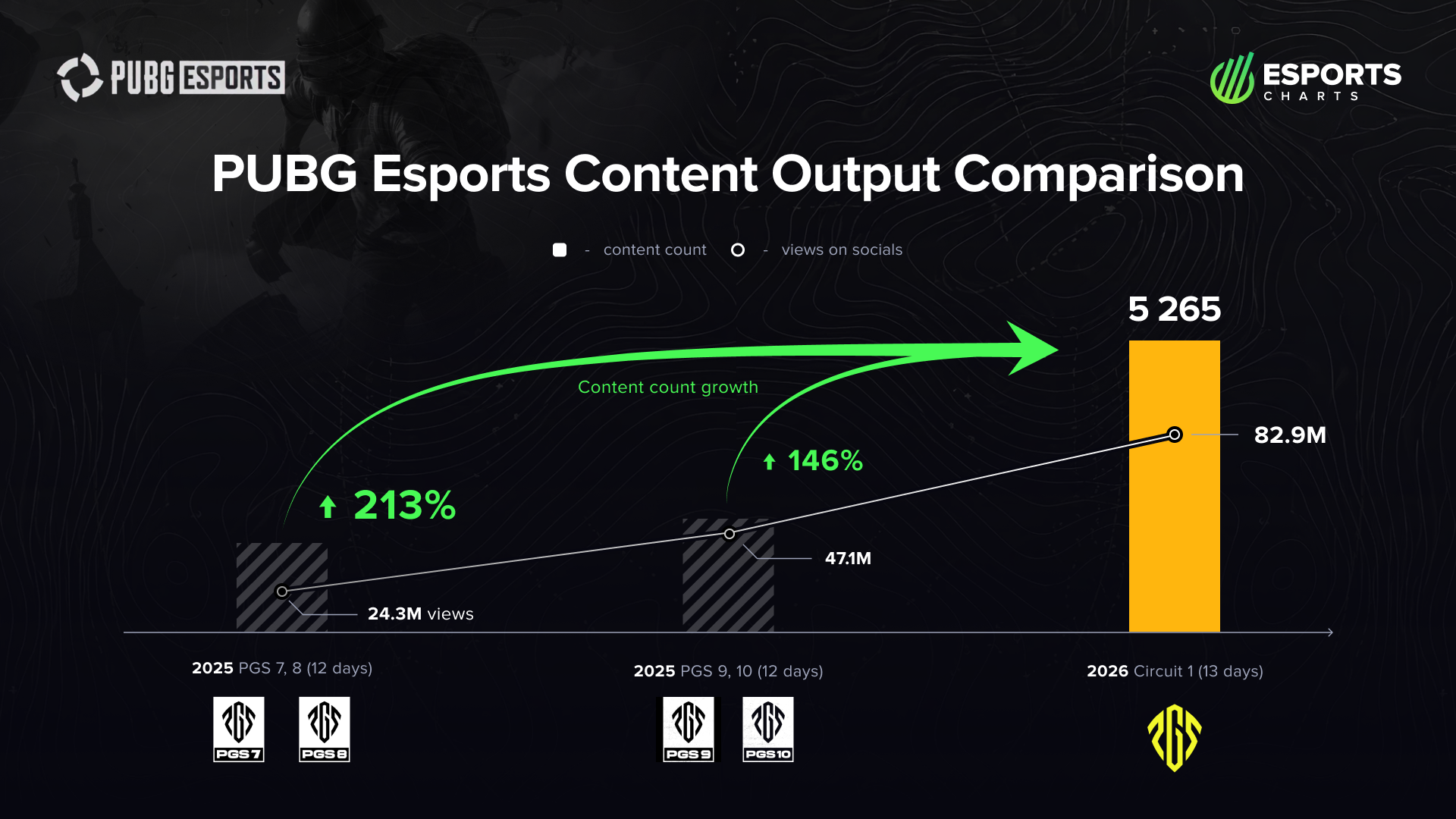
The 12 Global Partner Teams played a major role in this ecosystem, contributing an average of 160 pieces of content each. This high-frequency output, averaging 438 daily posts across all platforms, kept fan engagement high during breaks between live matches. This strategy resulted in over 82 million social video views, demonstrating that a high-volume, multi-channel approach can sustain visibility for a global audience throughout a multi-week event.

***
PGS Circuit 1 stands as a testament to the broader objectives of the 2026 season. The personalized viewing options and intense competitive schedule have set a new operational standard, showcasing how technical and structural advancements can alter how audiences engage with a competitive title.
The success of the initial phase provides a foundation for the remaining events of the 12-event season. Circuit 2 commences on May 20, where these engagement strategies will be applied to a seasoned group of competitors vying for PGC 2026 qualification.