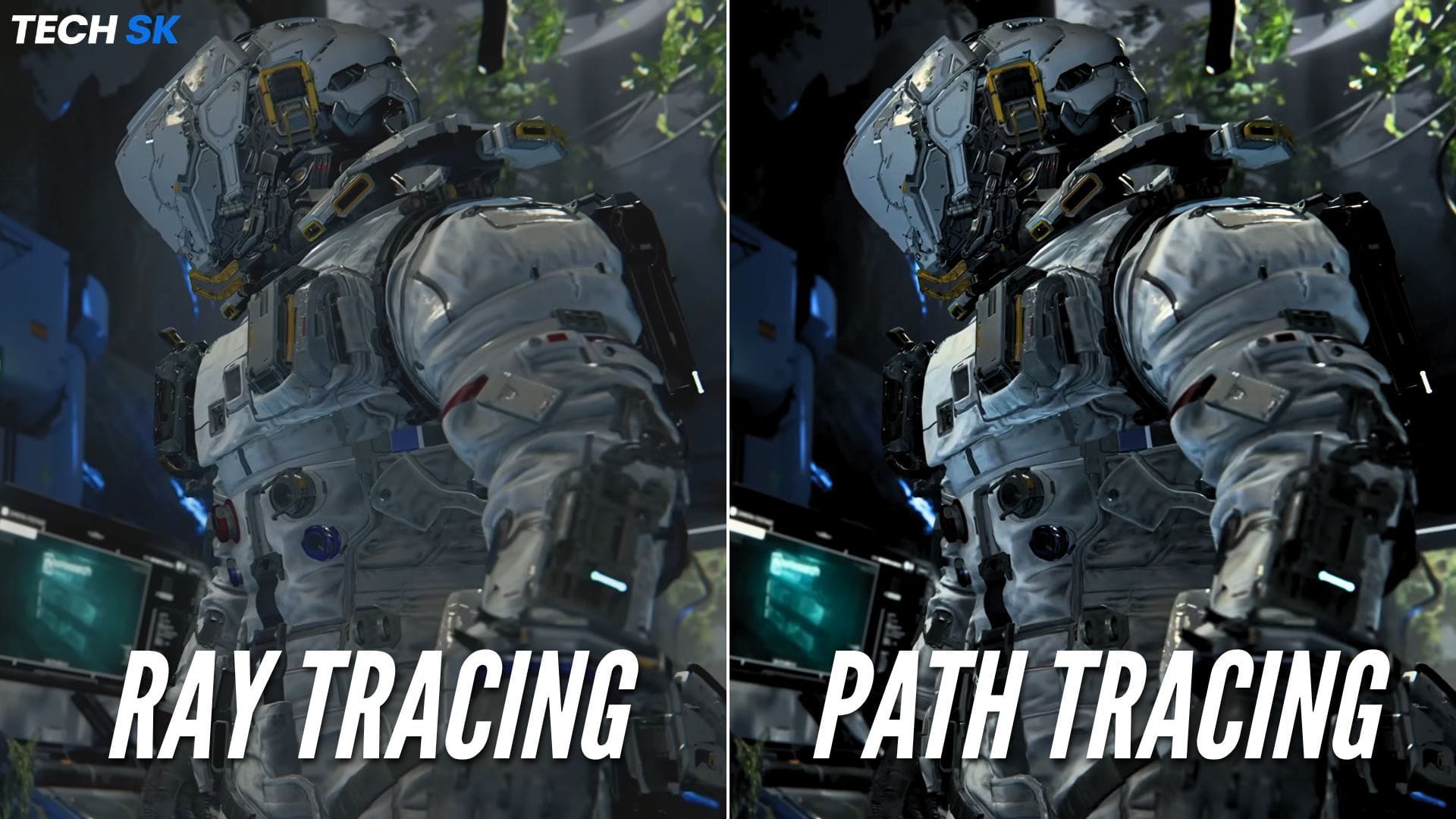
Capcom’s latest sci-fi shooter, Pragmata, is among the newest titles that come with support for ray tracing and path tracing. This game utilizes the same RE Engine as Resident Evil: Requiem, offering insight into how ray tracing and path tracing perform in a leading game engine in 2026.
The latest titles show a narrowing gap between ray tracing and path tracing, particularly on the latest Blackwell-based RTX 50 series GPUs. In this analysis, we evaluate the performance of the RTX 5070 Ti in Pragmata and compare it with RE: Requiem to identify any differences in trends.
Pragmata: Ray tracing and path tracing performance benchmarks
Initial tests on Pragmata indicate that it is a demanding title. Testing on the RTX 5070 Ti reveals that path tracing averages 69 FPS at 1440p, with DLAA further reducing it to 37 FPS. Let’s delve into the performance at both maximum and minimum settings to analyze the nuances of the GPU and engine.
For these tests, DLSS Super Resolution was configured to the Quality preset.
When using ray tracing at the lowest settings, the game achieves an average of over 200 FPS, suggesting a scenario where it is primarily CPU or engine-dependent. Enabling path tracing shifts the load to the GPU, resulting in an average performance of 82 FPS. Notably, with FG 4x, PT averages 213 FPS, but 1% lows drop significantly to 48 FPS, creating a “fake smoothness” effect commonly associated with DLSS 4.
At the highest settings, path tracing leads to a similar performance drop (162 to 69 FPS, a 2.35x reduction). The fixed overhead remains consistent, indicating that the setting is predominantly constrained by the hardware. This makes it conducive to DLSS Frame Generation optimizations despite the “fake smoothness” effect.
With high-end Blackwell GPUs, ray tracing has become more accessible, as evidenced by the 5070 Ti achieving an average of 162 FPS without any frame generation.
Contrasting Pragmata’s RT and PT behavior with Resident Evil: Requiem
We conducted tests on Resident Evil: Requiem under similar conditions on the RTX 5070 Ti at 1440p. The summarized results are as follows:
In Pragmata, PT incurs a ~2.5x cost compared to RT, whereas in Requiem, the difference is milder, ranging from 1.8-2x. The scaling in frame generation also varies, with Requiem reaching up to 4x native framerates, while Pragmata maxes out at 3x. This disparity may reflect differences in the rendered environments, with Requiem’s predominantly indoor settings potentially influencing the engine-level performance.
Of particular note is the behavior of lows with FG. Pragmata consistently experiences low degradation with FG, while Requiem demonstrates stabilization and occasional improvement. The FG integration in Resident Evil appears more refined and finely tuned by the developers.
Overall, Pragmata represents an experimental exploration of how the RE Engine can function in more ambitious titles. This leads to a scenario with high variability, occasionally falling short of the more polished RE: Requiem. It is possible that the new release represents an initial step towards a path-tracing-native rendering system, which could define the future of gaming.