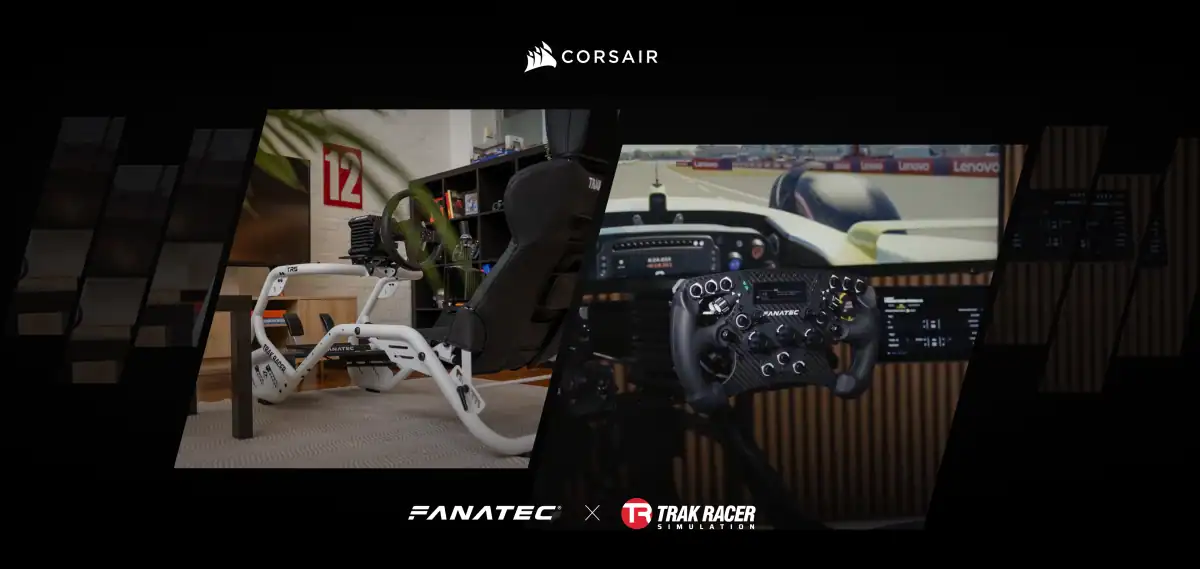
Corsair has completed the acquisition of Australian simulation-hardware company Trak Racer, further enhancing its presence in the high-end gaming sector where enthusiasts can invest significant sums of money to build elaborate systems.
The financial details of the transaction were not disclosed. Corsair has not specified the exact assets or liabilities involved in the deal, nor has it shared revenue or profitability figures for Trak Racer. Founder Matt Sten is set to join Corsair as the chief technology officer for Sim Solutions, as per the announcement.
Based in Melbourne, Trak Racer offers a range of aluminum-profile and tubular cockpits, seats, monitor mounts, motion and haptic systems, and flight-simulation products. Corsair stated that Trak Racer will complement Fanatec, the German sim racing brand it acquired in 2024, which focuses primarily on wheelbases, steering wheels, pedals, and shifters.
This move signifies a shift towards a more integrated product strategy: Fanatec provides the electronic controls, Trak Racer provides the framework, and Corsair can incorporate gaming PCs, monitors, streaming equipment, and other peripherals from its existing portfolio.
“Trak Racer significantly expands Fanatec’s sim racing offerings, bringing a wide range of cockpits and accessories as well as a dedicated, loyal community that we are thrilled to welcome to the Fanatec family,” said Corsair CEO Thi La in the official statement.
Sten emphasized the importance of distribution in this deal, highlighting Corsair’s global distribution network and retail infrastructure coupled with Fanatec’s engineering expertise and product range, which will help bring Trak Racer products to a broader audience while maintaining the brand’s community roots.
This acquisition builds upon Corsair’s existing presence in sim racing, which began before the company acquired Fanatec. In June 2024, Corsair unveiled a prototype modular sim racing cockpit at Computex, promising a versatile steel frame that can switch between upright GT and semi-reclined Formula-style positions.
A similar product is now marketed by Fanatec as the ClubSport GT Cockpit. It retains the prototype’s 50-millimeter round steel tube construction and adjustable GT-to-Formula seating, priced at €914.95 EUR ($799.99 USD) before adding a seat, which is sold separately by Fanatec for €339.95 ($299.99). A report by OverTake indicated that the Fanatec cockpit is essentially the rebranded former Corsair rig following the acquisition.
With the addition of Trak Racer, Corsair gains a broader and more established range of frames, accessories, commercial simulators, and motion-ready systems than what it had developed internally.
This also leads to some product overlap. Fanatec currently offers both the ClubSport GT and the more affordable CSL cockpits, while Trak Racer has its own competing aluminum and tubular platforms. Corsair has not disclosed whether these product lines will continue concurrently, be repositioned at different price points, or eventually be merged.
This acquisition follows Corsair’s acquisition of Fanatec’s operations from insolvent parent Endor AG in September 2024. Corsair did not reveal the specifics of the deal at the time, but subsequent filings valued the cash consideration at around $43.7 million, net of $4.5 million of acquired cash. Corsair also offset about $16.6 million in loans owed by Endor against the purchase price. Endor reported approximately $110 million in Fanatec product sales for 2023, a figure referenced by Corsair in its acquisition announcements.
Sim racing stands out as an appealing hardware category in competitive gaming due to the larger investment potential compared to traditional esports peripherals. While a typical esports player might replace individual components like a mouse or keyboard, a serious sim racer invests in an entire interconnected system comprising a cockpit, seat, wheelbase, steering wheels, pedals, displays, mounting hardware, a gaming PC, and possibly motion or haptic devices.
Trak Racer’s product range exemplifies this diversity. The TR8 Pro frame is priced at $699 on the company’s website and retails for approximately $690 through third-party sellers, while a TR160 V5 configuration with four D-BOX motion actuators is listed at $6,384, discounted from $6,720. Fully equipped turnkey simulators on Trak Racer’s regional stores range from about $15,400 to $35,000, depending on the components.
These prices offer opportunities for additional accessory sales and ecosystem expansion, although the higher selling prices may not necessarily translate into higher margins. Cockpits are large, heavy products that incur higher costs for storage, shipping, returns, and support compared to smaller peripherals. Corsair’s logistical and retail network could extend Trak Racer’s market reach, as highlighted by Sten, although physical retail entails more complex inventory and showroom management compared to direct online sales.
Furthermore, Trak Racer provides Corsair with a significant foothold in flight simulation through products like the TR550 Flight Simulator. In addition to this, Trak Racer’s product listings reveal licensing partnerships with Alpine’s Formula One team, Aston Martin’s F1 team, Porsche, Hot Wheels, and Airbus, expanding Corsair’s reach beyond esports into motorsports licensing and commercial simulation.
This strategic move comes ahead of Corsair’s scheduled second-quarter financial results announcement on August 6, following the Nasdaq market close. It remains unclear whether the management will discuss Trak Racer’s financial impact, integration costs, or projected revenue during that call.
Key details that are still undisclosed include the purchase price, specific Trak Racer entities involved, the company’s revenue and profitability figures, the retention of employees beyond Sten, the future of overlapping cockpit product lines, and the contribution of this deal to Corsair’s financial outlook.
For Corsair, this acquisition signifies a shift towards a more comprehensive systems approach in the sim racing sector. The challenge ahead lies in harmonizing the product development histories of its original cockpit, Fanatec’s existing lineup, and Trak Racer’s catalog without adding unnecessary complexity for customers and distribution partners.