Table of Contents

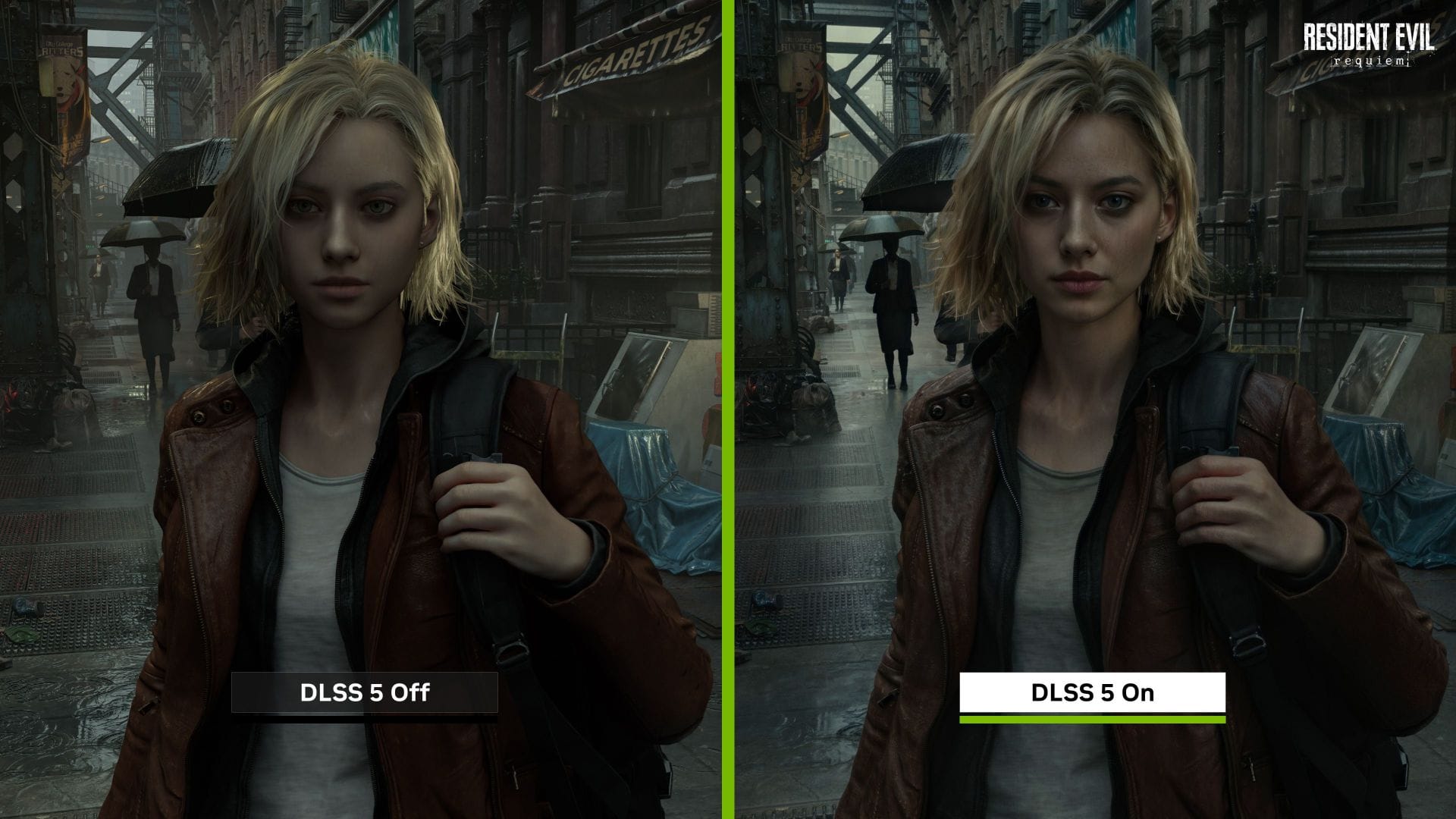
NVIDIA has recently unveiled its latest DLSS 5 technology set to debut this autumn. This advancement could potentially revolutionize the gaming industry by bringing a new level of realism since the introduction of real-time ray tracing in 2018. Unlike previous iterations of DLSS focused on enhancing performance through AI upscaling and frame generation, DLSS 5 will now improve lighting, materials, and intricate details in real time, offering a whole new realm of photorealistic graphics.
This signifies a shift in the company’s strategy towards transcending conventional methods and embracing artificial intelligence to shape the final appearance of each frame. While some hail it as a significant stride towards visual realism, others express concerns that the industry might be veering into what is bluntly termed as “AI slop.”
What is the Mechanism Behind NVIDIA’s DLSS 5?
Throughout the years, the primary goal of video games and their creators has been immersion. Despite the advancements like real-time ray tracing and path tracing making games more lifelike, achieving true photorealism has always been hindered by a key factor: computational power.
Even the most potent gaming GPUs need to render frames in milliseconds to ensure smooth and uninterrupted gameplay. In contrast to games, the visual effects in movies can take minutes or even hours to render accurately. This is where NVIDIA’s DLSS 5 comes into play, as instead of relying solely on traditional rendering methods, it employs neural rendering. Rather than tasking your GPU with calculating every minute visual detail in the frame, DLSS 5 uses AI to assist in completing the entire game scene.
Traditionally, the game engine would have to compute elements like lighting, reflections, shadows, and material properties, demanding substantial computational resources. However, DLSS 5 takes the color and motion vectors of each frame as inputs and employs an AI model to incorporate photorealistic lighting, grounding the output in the source 3D content.
Impact of DLSS 5 on Game Developers
NVIDIA’s DLSS 5 will transition a portion of the graphics pipeline from raw computation to AI prediction, enabling games to offer more cinematic visuals while maintaining a steady frame rate. Despite being a breakthrough in visual technology, every frame generated through DLSS 5 feels algorithmically hollow and lacks the subtle imperfections and intentional choices that lend visuals a human touch.
This shift from mere frame generation to crafting flawless character models and environments risks flooding screens with content that may seem impressive initially but ultimately appears generic. There are apprehensions about how creators themselves seem apprehensive that the overreliance on AI tools might sideline skilled artists, reducing their roles from creators to mere overseers of machine output.
To ensure that developers retain artistic control in their games, NVIDIA is furnishing special tools that will empower studios to adjust how the AI enhancements are implemented in games. Thus, rather than solely depending on DLSS 5’s AI generation, developers can fine-tune the intensity, color grading, and selectively mask specific parts of a scene, deciding where and how enhancements are applied to preserve the intended visual style.
Public Opinion on DLSS 5
The reception towards NVIDIA’s DLSS 5 has polarized the internet into two distinct factions. One faction comprises players and tech enthusiasts who view DLSS 5 as the natural progression of real-time graphics, while the other faction encompasses a growing segment of the community labeling this direction as “AI slop.”
While proponents of DLSS 5 perceive it as the moment when gaming finally begins to resemble Hollywood-level visuals, skeptics cast doubts on the technology. To them, DLSS 5 not only optimizes performance but also risks supplanting handcrafted visual design, leading games to appear more polished and uniform, devoid of those subtle imperfections that render art human.
Meanwhile, for advocates, neural rendering represents the next progressive step in computer graphics, akin to the trajectory real-time ray tracing followed. While ray tracing initially sparked controversy, it is now widely embraced.
Ultimately, NVIDIA’s DLSS 5 finds itself at the core of a significant debate, posing the question: should realism be attained through artistic endeavor or through AI-powered approximation?
Edited by Abu Amjad Khan