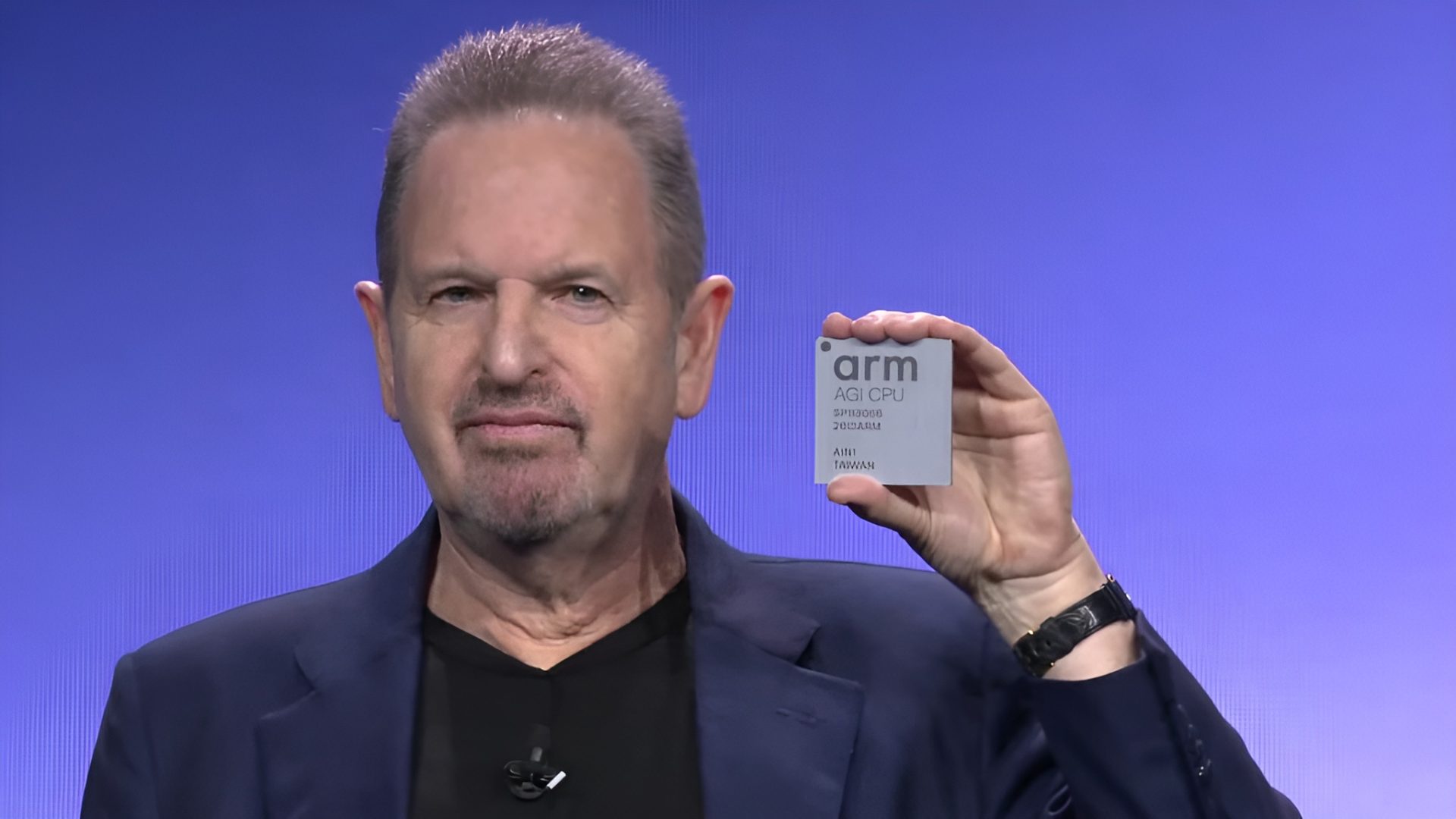
ARM’s Chief Executive Officer is confident in the company’s move into the server CPU market, stating that the AGI CPU is designed to challenge the dominance of x86 in the industry.
ARM CEO Affirms Their Latest AGI CPU Won’t Upset Partners Like NVIDIA, But Will Pose Challenges For Intel/AMD
During a recent keynote, ARM made a surprising announcement where CEO Rene Haas revealed a shift from being solely an IP company to becoming a compute provider. The company also introduced its first-ever server CPU, the AGI CPU. While ARM’s decision has been met with skepticism, Haas’s revenue projections have generated optimism, as the AGI CPU is predicted to bring in approximately $15 billion in annual revenue by 2031, driven by its rack-scale configuration. Interestingly, ARM’s CEO spoke with WIRED to discuss the company’s new direction, highlighting the core reasons behind it:
Why build a chip? As a compute platform company, there are occasions when the ecosystem benefits from your direct hardware involvement. We’ve seen this before, such as Microsoft creating a Surface laptop to enhance the Windows ecosystem, while HP, Dell, and Lenovo continue producing laptops; or Google developing a Pixel phone alongside Samsung’s Android phones.
– ARM’s Rene Haas
ARM’s CEO emphasizes that their foray into compute provision is primarily aimed at expanding the reach of the company’s IP offerings to a broader market, thereby enlarging the company’s customer Total Addressable Market (TAM). Haas draws parallels with Microsoft’s Windows and Surface laptop shipments, suggesting that the latter has boosted the adoption of the company’s operating system. He asserts that with the AGI CPU, the ARM ecosystem gains significant strength, catering to the burgeoning demand in the agentic AI sector, driven by the increased need for processing units due to agent orchestration and management workloads in recent months.

Mentioning Microsoft serves as a strategic move by ARM’s CEO, although it’s crucial to acknowledge that ARM has enabled its competitors to develop competitive solutions for various markets. Specifically in the context of data centers, ARM’s IP holds sway in CPU offerings from NVIDIA and Amazon, positioning the AGI CPU in a market where ARM is both a rival and an ally. Given ARM’s close collaboration with its customers, there may be reservations among them about sharing chip designs and architectures now that ARM is a direct competitor.
The history of the ARM-Qualcomm dispute in the mobile sector serves as a clear indication that competing in and serving similar markets can pose challenges, potentially impacting the IP provider in the long run. Interestingly, ARM’s CEO was questioned about potential conflicts of interest with partners like NVIDIA, to which he responded:
Question: You’re referring to the fact that it’s Intel’s x86 architecture versus Arm architecture. So you don’t think you’ll upset your friend, Jensen, but that AMD and Intel may react to this.
ARM’s CEO: I use “upset” in a light-hearted manner. It benefits the Arm ecosystem and Jensen for us to develop a chip. Having [Nvidia’s] Vera chip, a commendable product, alongside the Arm AGI CPU, another excellent product, isn’t favorable for Intel and AMD, that’s all I know.
ARM expresses confidence in its ability to compete with x86 in the server CPU realm with its AGX CPU, yet uncertainties linger regarding its adoption prospects. Currently, the primary customer for the solution is Meta, set to incorporate it into its rack offerings, likely alongside the MTIA ASICs. Haas does mention other customers like SK hynix, Cisco, SAP, and Cloudflare, but the adoption outlook hinges not only on the clients ARM can attract but also on the company’s ability to maintain production. The AGI CPU is being manufactured at TSMC using the 3nm process, and securing capacity has been a challenge in recent times.
The AGI CPU represents a significant advancement by ARM and its manufacturing team. However, the focus now shifts to whether the company can capture market share, with several obstacles to overcome, especially when contending with established players in the industry.
Follow Wccftech on Google to get more of our news coverage in your feeds.
Please rewrite the text for me.