
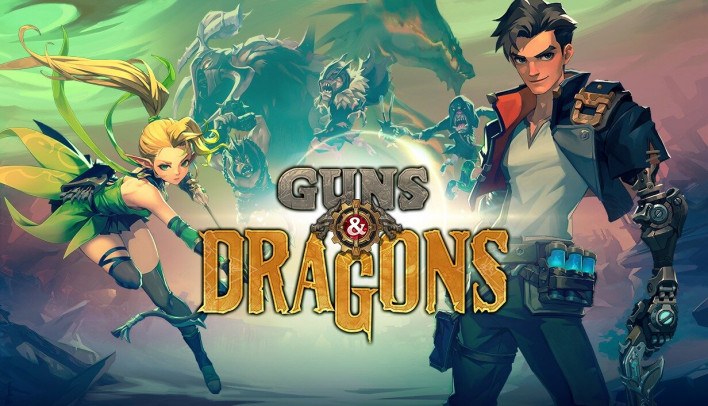
A month ago, a playtest was held for ‘Guns & Dragons’, a new title from rookie developer AButton. As a “roguelite FPS”—a subgenre mostly explored in the indie scene with few attempts made domestically—it naturally drew interest, but the background behind its development was somewhat surprising. Guns & Dragons wasn’t their debut title, nor had their first game even launched yet. With developer AButton actively running marketing campaigns ahead of the release of ‘ZEUS: God of Pride’, the playtest announcement for Guns & Dragons was certainly unusual.
Joining the test with light expectations while all eyes were on ZEUS, Guns & Dragons turned out to be a game with potential that shone far brighter than expected. Of course, based on the test build, there were unpolished systems, unintuitive mechanics, and plenty of shortcomings—but isn’t finding the “right path” precisely what testing is for? The game’s core logic and content structure were extremely intriguing, making the two-week test a genuinely enjoyable experience.
And we met them again at Gamescom 2026 in Cologne, Germany. Apart from ZEUS, we sat down to talk about the game with Director Junwoo Park and PM Iksong Kim, who are sprinting toward the Early Access and official launch of Guns & Dragons.
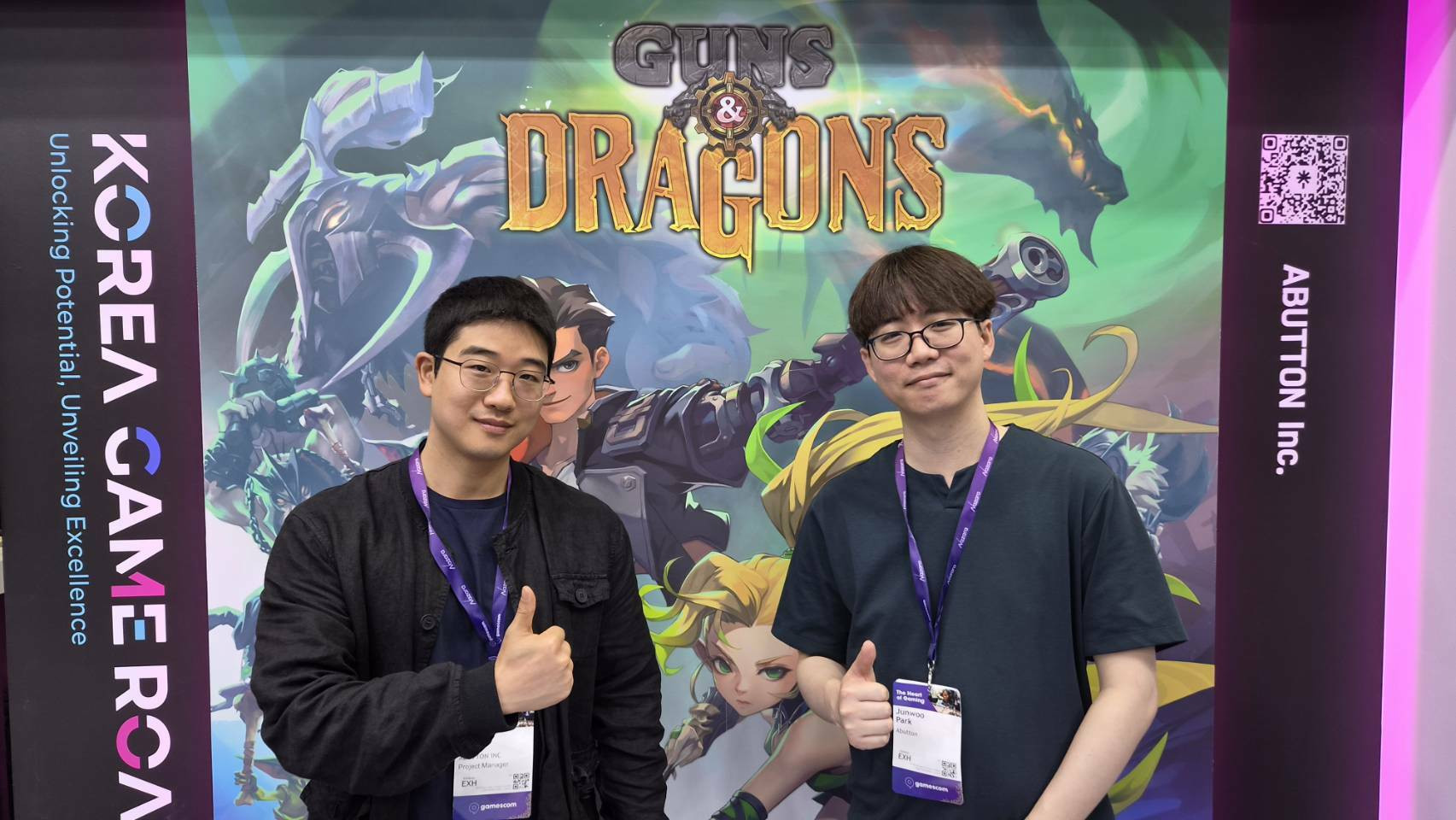
AButton is currently developing two projects simultaneously: ZEUS and Guns & Dragons. This is an unusual choice for a new studio. What is the reason behind running both projects together?
Director Junwoo Park: While I can’t claim to know 100% of our CEO’s exact thoughts, we believe that even if a new studio makes a great first game, they often fall into the “one-hit wonder” trap. That’s why we view it as crucial to establish ourselves as a developer that continuously builds games by maintaining a continuous development pipeline.
To achieve this, we are broadly running our projects under a “Big & Little” strategy. In markets where you compete on quality and scale, we build “Big” projects like ZEUS that showcase what we do best through sheer scale and content volume. Meanwhile, with “Little” projects, we flexibly tackle novel ideas, relatively uncharted markets, and global audiences. Going forward, we envision alternating development between these two types of projects in their respective cycles.
Guns & Dragons falls into the “Little” category. Out of so many genres, why did you choose a roguelite FPS?
Director Junwoo Park: We set FPS as our core keyword right from the start. Our CEO is someone who couldn’t let go of his passion for FPS games, and I have also been working on FPS projects for a long time.
However, most FPS titles today are cutthroat, hyper-competitive PvP games. So we thought, “Let’s make a multiplayer FPS that we can genuinely enjoy playing.” To achieve that, we tried using roguelite mechanics to set the pacing. Upon researching, we saw games like Gunfire Reborn and realized there was potential in this genre. Through R&D, we’ve been shaping the game into what it is today.

Many other roguelite FPS games involve constantly acquiring and swapping weapons during a run. In contrast, Guns & Dragons is structured so that you continuously evolve your starting weapon. Is there a reason you chose this approach?
Director Junwoo Park: We boldly discarded that element of fun. That’s because our starting point was creating an FPS that players who struggle in PvP FPS games could also enjoy. In my case, no matter what game I play, I almost never use sniper rifles. However, in games like Gunfire Reborn or Roboquest, if a high-rarity sniper rifle drops, you feel forced into a situation where you think, “It’s a good weapon, so I have to use it.” In the FPS genre, we felt that might be pushing players too hard.
While not an FPS, Hades lets you pick a weapon from the start and build intricate setups around it. We thought that if a single weapon has enough depth, there’s no need to force players to use a weapon type they don’t want.
Of course, when players first experience the game, they might wonder, “Why aren’t they showering me with various weapons right from the start?” However, we noticed that in other games, once players get familiarized, they eventually converge on a few powerful firearms anyway. We figured it would be better to let players dive deep into customizing a single gun instead.
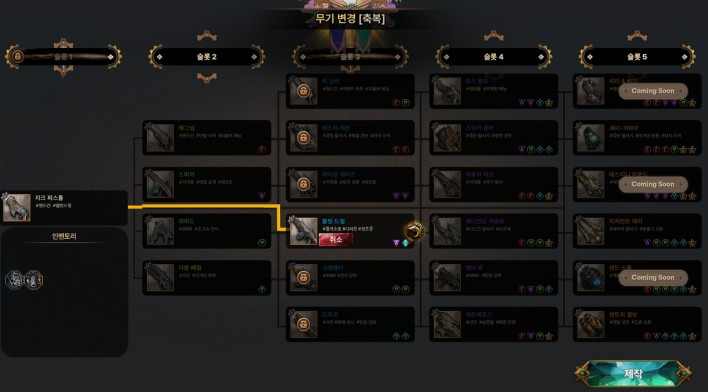
In return, cores obtained from other weapons can still influence the weapon you are currently using. If you want to keep using an SMG but no appealing new SMG drops later, you can upgrade your existing SMG enough to keep playing with it. Through this, players naturally get exposed to other weapons little by little, gently encouraging them to try a different build in their next run if something catches their eye.
The last playtest ended once players defeated the first boss. How far along is that in an actual single run?
Director Junwoo Park: Looking at the current overall scale, it’s about one-third of the way through. A single run is planned to span up to Chapter 3, and as players near Chapter 3, they will be able to craft final-tier weapons.
During the playtest, some felt that combat spaces were narrow or that map layouts were hard to read at a glance. Director Junwoo Park explains that they are approaching feedback regarding level design by actively listening to player feedback and making adjustments based on that feedback. They have already made changes such as removing environmental structures and adjusting object density to improve the overall gameplay experience. They are also considering changes to monster spawn distances and door mechanics to address movement restrictions and combat encounters.
Additionally, they are planning to revisit the design after art passes to refine the spaces further. The primary goal of the playtest was to gather feedback and make fixes, and they have been pushing out updates quickly based on the feedback received. They are open to making necessary changes to improve the game based on player input and observations. This was especially evident in the upgrades to skills upon leveling up. We do not aim to enforce strict balancing and if players discover an overpowered combination, we want to acknowledge it and say, “Great find!”
Are there any new weapon categories you plan to introduce in the future?
Director Junwoo Park: Next on our list are cold weapons (melee/throwing weapons). We are considering area-of-effect attacks with swords or blades, as well as throwing weapons like shuriken.
Instead of implementing complex melee combat like Chivalry, we are aiming for something closer to Overwatch. Incorporating deep melee mechanics into our current system structure would be challenging.
Boss battles are designed to be distinct from mob encounters in terms of spatial design and strategy. What criteria do you prioritize when designing bosses?
Director Junwoo Park: Our main focus is on creating a sense of continuity by designing boss encounters alongside the elite monsters in that zone. When designing boss patterns, our baseline rule is that players should be able to defeat a boss on their first encounter as long as they observe calmly and have basic mechanical reaction ability. We also provide tactical solutions to help players overcome mechanics, even if their mechanical execution is weak.
Players felt significant pressure from blacksmith enhancement costs and failure rates during the playtest. How are you adjusting this system?
Director Junwoo Park: Gold is a resource used only within a single run, while resources like wood and stone are brought back to camp for base building. In response to player dissatisfaction with blacksmith costs, we have drastically reduced the price from around 200 Gold to roughly 50 Gold. We have also made changes to allow multiple enhancement attempts and adjusted pricing accordingly.
You received a lot of player feedback during the playtest. How do you evaluate situations where player feedback conflicts with the dev team’s vision?
Director Junwoo Park: While we don’t blindly adopt every piece of feedback, we do what we believe is necessary. For feedback that we disagree with, we aim to explain our reasoning to players clearly. I personally engage with players on Discord to address their questions and concerns.
Do you have any final words for players eagerly awaiting Guns & Dragons?
Director Junwoo Park: Despite lower-than-expected domestic interest in Korea, our game offers challenging mechanics and depth for players to explore. We are working hard to deliver a great game and hope you will keep an eye on us.
Our newsroom carefully reviews and refines all translations assisted by AI technology.