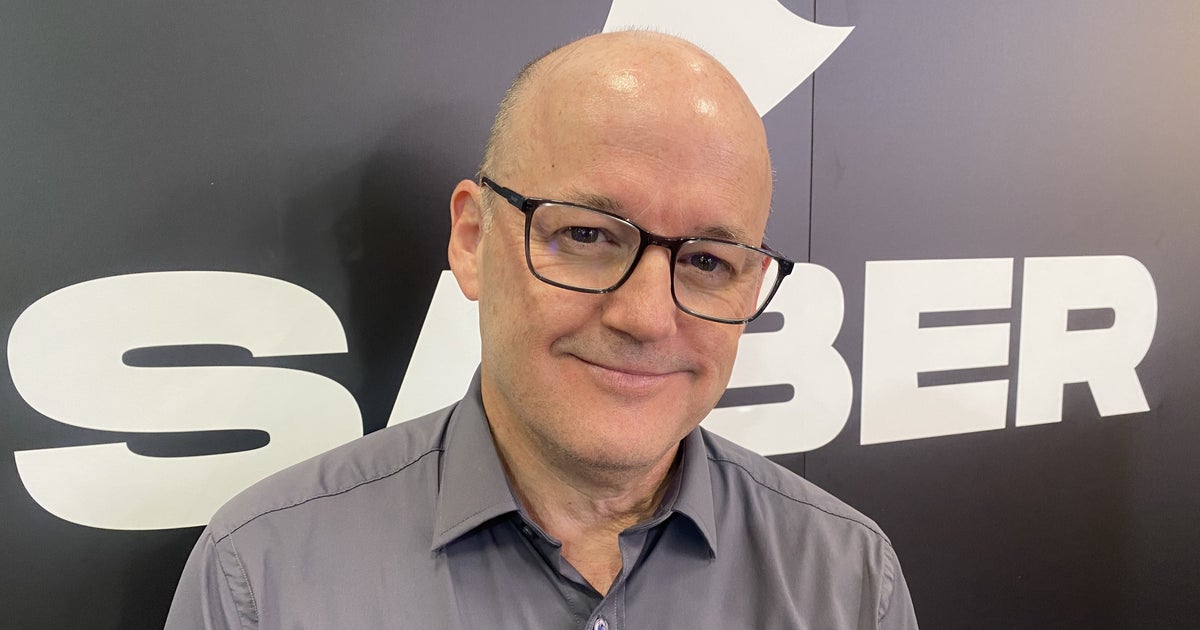
Saber Interactive has achieved a lot in the past few years, but the most noticeable recent news to come out of the company was CEO Matthew Karch’s unfiltered response to accusations that a writer had been replaced with ChatGPT. When we sit down at Gamescom for the second of two conversations with Saber Interactive’s chief creative officer Tim Willits, it’s the first thing we ask about.
“That’s just Matt’s sarcasm, that’s all,” he says. “But the important thing is that we’ve never replaced anybody with AI. That’s crazy. And we don’t use generative AI in Space Marine, and Hellraiser, and Stuntman, and everything.
“But we are experimenting with it, because we don’t know where in the industry it’s going to be effective, where people will like it, where it’s useful. In Rideshare Stimulator, we are experimenting with it with the AI mode. Very clear that the other stuff was all written by humans. Even the side missions were all written by humans.”

He believes that in the future, we will probably see a developer “come up with such a clever and brilliant use case for true modern AI integration, everyone will be like, ‘Oh, that’s it’, and everyone will understand that that’s how it can be. But until that happens, it’s like other technologies throughout history. When they first come out, people are like, ‘What are we going to do with this technology? How’s it going to work?’ And then we all discover that it’ll fit into everyday life.”
Willits says that Saber doesn’t use generative AI in its production pipelines for things like code, environments, or textures. But he does see the benefits of the technology. “One of the things that I always wished that I could do in my career is draw, because I always felt I would have been a better designer if I could actually draw… So for me, one of the things that helps me is if I can have a vision in my head and I need a way to get it out, it’s something that I can definitely use.”
“It will be interesting to see where it goes. And I bet at next year’s Gamescom, I think we’ll have some bigger games that actually focus on it. And I’m curious to see how it plays out for us, I’m curious to see how it works in our Rideshare game, and how people are going to like it. It’s a great experiment.”
Eggs and baskets
Saber Interactive split from Embracer in 2024, in a process that Willits describes as “very easy”. It remains a huge company, numbering 3,500 employees spread across 15 studios in places like Serbia, Armenia, Georgia, Spain, Portugal, Sweden, Argentina, and Australia. “Now that we’ve started a game in Australia, the sun no longer sets on Saber development,” says Willits.

Notably, North America doesn’t appear on that list. The firm has “no real development in North America any more,” says Willits, although the company retains its headquarters in Florida and a publishing team based in the USA.
It’s a sign of the times: as ASGC’s Amir Satvat put it, “Head count moving from basically North America to basically anywhere else.” Saber has embraced this. “We are not afraid of any territories. Some publishers are afraid to work in territories they don’t understand, but we’re like, let’s go, let’s find some people that are talented, let’s give them what they need, and let’s make awesomeness. You don’t need to be in California to be a brilliant programmer or artist or animator.”
Willits is the guy who’s keeping it all ticking over. “My job is to just make sure the teams have what they need, make sure that they’re focusing on what’s key, make sure scope doesn’t get out of hand,” he says. And there’s a lot to keep an eye on.
“People have heard me criticise old-fashioned modern publishers that put all their eggs in one basket: they have these siloed teams that focus on one project,” says Willits. Saber, by contrast, has a lot of eggs, and a lot of baskets, along with the flexibility to move teams across projects as needed.

The company has its tentpole releases, like the upcoming games Stuntman: Hollywood, John Wick, Turok: Origins, and Jurassic Park: Survival. It pairs them with what Willits calls its “bread and butter stuff”, like the remaster of the original Hitman trilogy, which follows remasters of Tomb Raider, Crysis, and Halo. “That’s predictable, consistent work where you make money,” he says.
“And then we have our smaller bets, like Docked and Bus Bound. Rideshare’s like that. They’re predictable, we know what we’re going to spend, we can predict what we’ll make. And then we have a culture that lets people work on all different games. So nobody feels that they’re only on game A or game B, and we can pull resources from around the world to put the attention on a game when it’s needed.”

Willits says Saber is also exploring movie-style external development models. “We are talking to groups of people, like 18 to 20 super-talented developers in the US, that we can partner with.
They provide the creativity, genius, and vision, while we offer the manpower. Instead of having a large group of 300 people in California waiting for concept art and quickly depleting funds, we prefer to have a small, focused team working on the essentials, with the ability to bring in additional resources when needed.
Every film studio and every holder of a major franchise is eager to venture into the world of video games, recognizing it as a space where the audience is most engaged.

Saber’s scope extends beyond movie adaptations as it also delves into other gaming intellectual properties. Willits commends the partnership with IO Interactive for the upcoming Hitman Classic Trilogy Remastered. “Both parties bring unique ideas to the table because our aim is not merely to remaster games but to enhance them wherever possible. We aim to respect the essence of the franchise without causing disruptions – a concern that fans may have when hearing such statements. However, the outcome should be exciting.”
“We can do something with 12 people if it’s cool”
“Our involvement in the Tomb Raider remasters involved subtle enhancements that catered to fan preferences. Our focus is always on aligning with the game’s core while incorporating desired improvements. This is why collaborating directly with IO is advantageous, given their deep understanding.”
Aside from collaborative projects, Saber is nurturing its own gaming properties. Willits points out the driving game MudRunner as a brainchild of an individual within the company, reflecting a culture that encourages exploration of new concepts. Saber’s interest spans from small-scale projects to large ones like John Wick. “We are capable of achieving significant outcomes with a team of 12 if the concept is compelling. For instance, MudRunner evolved into SnowRunner, which saw great success. This progression led to Expeditions, RoadCraft, and the innovation of Road Kings technology.”

The underlying principle is to foster an adaptable environment where individuals can pursue projects that resonate with their interests. “We are in the business of creating video games. It’s a privilege, and if someone has an innovative concept, we are open to exploring it.”
On a broader scale, Willits advocates for discipline within the industry. “Developers must exercise discernment and concentrate on essential aspects. A remarkable game can be crafted with a small team, emphasizing the importance of strategic decision-making in game development.”
“Establishing a culture that allows individuals to contribute to multiple projects concurrently is crucial. Avoiding isolation and promoting collaboration across teams is key to sustainable progress.”
Please rewrite the text you would like me to assist you with.