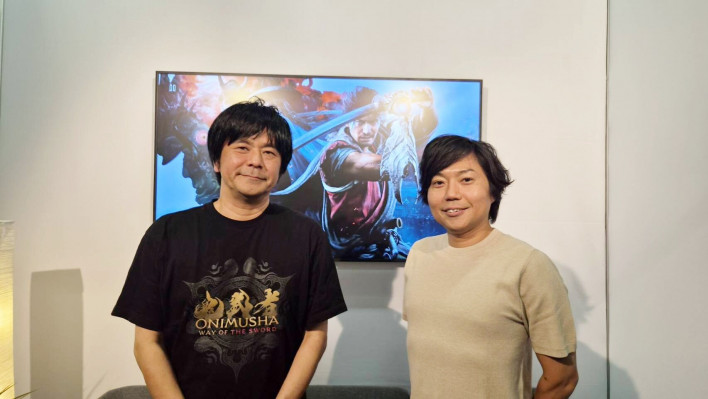
On the first day of Gamescom 2026, we visited the Capcom booth and reunited with Producer Akihito Kadowaki and Director Satoru Nihei, whom we had interviewed several times before. Months ago, and even a year ago, there was still time before launch, leaving room for many things to change, but not anymore. Launch is literally “imminent.” While it hasn’t gone on sale yet, ‘Onimusha: Way of the Sword’ is already a finished game.
On top of that, “Oni Transformation” was revealed during Gamescom Opening Night Live, showcasing how the protagonist, Miyamoto Musashi—who denies everything about Oni and is reluctant to use their power—comes to embrace the Oni power. We sat down for an interview to hear as much as possible before launch.
As a brand-new title returning after 20 years, there must have been a lot of contemplation balancing the feel of the past with modern changes. What was the hardest element to maintain while modernizing ‘Onimusha’?
Satoru Nihei: If I had to pick the most difficult part, it would be soul absorption. In ‘Onimusha,’ players had to stand still while absorbing souls, which served as a crucial risk-reward element in combat. Stopping your movement created risk, but it offered a corresponding reward.
However, in modernizing this, we felt that stopping movement to absorb souls could feel quite stressful to today’s players. Modern games generally allow players to perform various actions while moving. So we went through a tremendous amount of trial and error regarding how to maintain the existing risk-reward balance and tension while allowing players to absorb souls on the move, which eventually led us to its current form.
Given the long development period, some aspects must have changed significantly from the initial concept to its current form. Which system changed the most during development?
Satoru Nihei: Ultimately, the system that changed the most was actually one that was removed. Initially, there was a stance-switching system between a two-handed stance and a one-handed stance. Each stance had different actions and mechanics tied to it.
For instance, actions like parrying and deflecting that remain in the current game were originally tied to individual stances. However, when we actually implemented it, the controls became more complicated than we intended. In the end, to optimize controls and make gameplay more accessible, we scrapped the stance-switching system altogether.
However, its traces haven’t vanished completely. The signature actions tied to each stance have been carried over into the current core combat system. In that sense, I think this area underwent the biggest change.
Recently, sword-based action games have become very common. What did you focus on most to set this game apart from other modern swordplay action games?
Satoru Nihei: I’d say it’s “Deflect.” While many other games have parry-like systems, in this title we implemented movements where you deflect incoming attacks from various directions and seamlessly transition into attacks in other directions. I believe these movements are quite rare in other games.
At the same time, we didn’t stop at just making it look cool; we tied it into signature ‘Onimusha’ fantasy elements and gameplay mechanics. For example, successfully deflecting consecutive attacks enters a “Blazing State” represented by blue flames. We feel that linking action, ‘Onimusha’-unique fantasy, and actual gameplay mechanics together is a defining feature of this title.
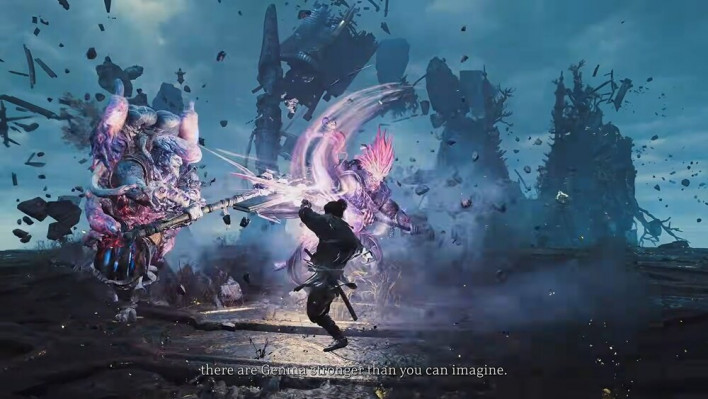
In the past, Issen was a system where the feel of combat changed dramatically depending on mastery. Did you design it again so that combat style changes as players become more skilled?
Satoru Nihei: In a sense, that feel remains the same as in previous games. Issen involves taking big risks, but the reward for landing it is equally huge. Players who played past ‘Onimusha’ games a lot might remember shifting their playstyle to constantly fish for Issen as they got better.
In this game as well, players might find using Issen difficult at first. But as they get used to it, they’ll want to try taking down enemies using only Issen. We made sure to preserve that uniquely satisfying feel and appeal of Issen.
On top of that, as you grow Musashi through the skill tree, Issen’s damage increases further. We designed it so that players always have a compelling reason to keep aiming for Issen as the story progresses and enemies grow stronger.
This time, alongside the classic Issen, a new option called “Break Issen” was introduced. How did you balance Break Issen so it wouldn’t diminish the tension of the classic Issen?
Satoru Nihei: Because Issen carries high risk and high reward, it’s a system with immense tension. On the flip side, because it’s difficult, some players didn’t bother trying it at all. In fact, in past entries, there were players who beat the game barely using Issen.
This time, we wanted everyone to experience the thrilling satisfaction akin to Issen. By deflecting or parrying enemy attacks to deplete the enemy’s gauge, players can execute a “Break Issen,” allowing anyone to experience highly dynamic Issen animations.
That doesn’t mean the reward or significance of the classic Issen has vanished.
The classic Issen remains unchanged, while Break Issen provides an alternative for players unfamiliar with action games to enjoy the satisfying feeling of Issen. Musashi is a character who aims to become the strongest through his own abilities and rejects the power of Oni. At ONL, the “Oni Awakening” was introduced as a more aggressive utilization of that power. The process of embracing Oni power is left for players to explore and understand while playing the game. As players progress in the game, they gain access to more powerful techniques and options. Issen remains an important option throughout this process as it provides a sense of satisfaction and accomplishment when successfully executed. Musashi’s “Oni Awakening” is a key aspect of the game, allowing players to feel a sense of achievement and skill. The game is designed to reflect a young and unrefined Musashi who is still in the process of perfecting his swordsmanship. Various Oni Weapons in the game serve as special attacks rather than primary weapons, connecting with the image of Musashi being portrayed. The Genma in the game are designed to be memorable characters with unique backgrounds, personalities, movements, and combat styles. There are still surprises in the game that have not been revealed yet, encouraging players to explore and discover them on their own. The developers express their gratitude to Korean fans for their interest in the game and hope they look forward to its release.
Our newsroom meticulously reviews and enhances all translations assisted by AI technology.