
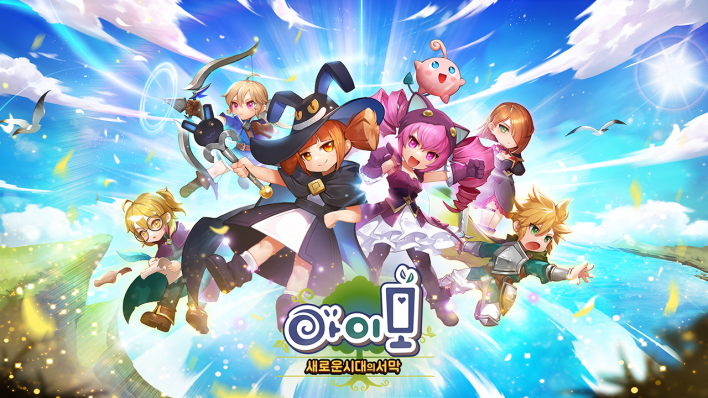
IMO’, a mobile MMORPG developed and published by Com2uS, has reached its 20th anniversary this year. In an industry where mobile games often struggle to survive even a single year—to the point where ‘half-anniversary’ celebrations have become a common concept—’IMO’ has stood the test of time for two decades. What has been the driving force behind its longevity? We had the opportunity to sit down with Studio Head Kim Nam-ho and Team Leader Lee Yong-jin, who are currently in charge of ‘IMO’ development, to discuss the secrets behind its 20-year success, share some stories, and look at future plans.
‘IMO’ Celebrates 20 Years with Its Users; May Event Announced.

IMO has reached its 20th anniversary. Could you share your thoughts on this milestone.
Studio Head Kim Nam-ho = I don’t think it’s common for a game to reach its 20th anniversary, even on a global scale. It has been an eventful journey, but I believe we were able to make it this far because our users stayed with us.
Team Leader Lee Yong-jin = Since this is literally a ‘service’, I believe ‘IMO’ has been able to last this long thanks to the users who are the core of that service. We will continue to work hard, so we hope you will keep supporting us.
A ‘Martial Artist’ class was added for the 20th anniversary. Could you tell us about the motivation and process behind adding this class.
Lee Yong-jin = We had wanted to add a new class for a long time, but other tasks had to take priority. First, the engine was quite old, making it difficult to implement a new class effectively. We chose to undergo an engine renewal, and with other considerations like game balance and securing operational funds, it was pushed down the priority list. However, we developed it step-by-step and were finally able to introduce the new class for the 20th anniversary. The user response has been positive, so we are open to working on more new classes if the opportunity arises.
You also went through an ‘engine replacement’ and ‘renewal’. Was there anything specific you wanted to show the users through this process.
Kim Nam-ho = We decided that an engine replacement was not an option, but a necessity, if we wanted to continue operating ‘IMO’. We spent three to four years on this, which allowed us to implement features like ‘high-resolution graphics’ and ‘expanded expression ranges for new classes’. I can’t say for sure how many more years we will be able to provide service, but I want to keep making a game that brings joy to our users.
I have a follow-up question regarding the engine replacement. Why didn’t you release it as a new version, like a remaster, and were there any negative reactions to the changes.
Kim Nam-ho = As you mentioned, an engine replacement can change the feel of controls and gameplay. The development team debated whether to release it as a new game called ‘IMO Remaster’ or to replace the engine of the existing game. Ultimately, we decided that launching a new game might make users feel a sense of loss or deprivation regarding what they had built up over the years, so we opted to upgrade the graphics of the existing ‘IMO’. Once we set that direction, we invited users to provide feedback on the engine replacement. We even went as far as to preserve certain ‘buggy’ gameplay elements from the original—such as the auto-move feature triggered by opening the inventory while pressing movement keys—to ensure we didn’t lose the original’s charm.
What is ‘IMO’s’ strategy for attracting new users alongside the existing player base?
Lee Yong-jin = I think the aspects that appeal to modern users are ‘manual controls’, ‘PvP guild wars’, and ‘cute pixel art graphics’. To help new users adapt to this content, we are creating an environment where they can gradually fall in love with the game by providing friendly quests and engaging costumes.
Kim Nam-ho = To provide a more comfortable play experience, we fixed data transmission issues that dated back to the feature-phone era, improved the UI/UX for better visibility, and increased accessibility by launching a PC beta version alongside the mobile version.

What is your current position or schedule regarding the ‘Ganesha Server’.
Lee Yong-jin = For the Ganesha server, we consider the official service to be one where all servers can play the PC version. Our top priority is ensuring the mobile experience translates well to the PC, and we are currently receiving user feedback and fixing bugs through the beta service. We are also still refining the UI/UX layout. We are aiming for a full service launch in the second half of this year.
You mentioned macros during a live broadcast last December. Since you are planning a full PC service launch in the second half of this year, what internal measures are you taking to manage these macros.
Lee Yong-jin = Macros generally fall into two categories: ‘battlefield macros’ and ‘hunting macros’.