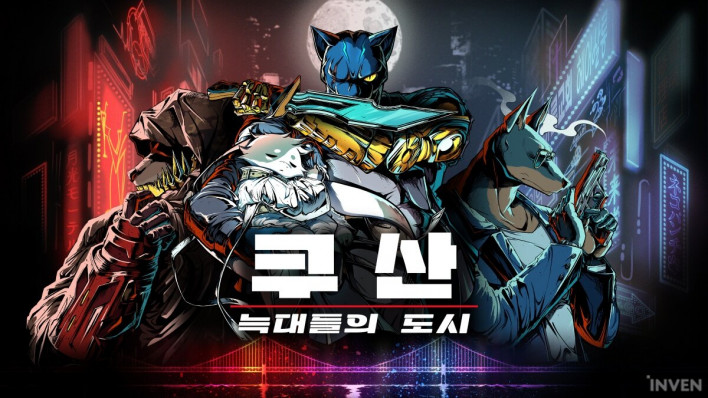
Kusan: City of Wolves Key Art ©CIRCLEfromDOT
Everyone has a favorite game that inspires them to create something similar. Some may even go on to develop games that imitate or follow in the footsteps of their favorite titles. However, it takes a great deal of dedication to nurture that passion for eight years and transform it into something entirely new. This is exactly what the small Korean studio CIRCLEfromDOT has accomplished.
Development of their game, ‘Kusan: City of Wolves,’ began in 2018, with ‘Hotline Miami’ serving as the initial inspiration. But this wasn’t just about copying the game; it was about using it as a reference point to gauge the fun and tension of development. This led to the creation of a game that can be described as a ‘Cyborg John Wick in Hotline Miami,’ set in a neon-noir city called Kusan, with its own unique identity.
Now, after moving beyond the goal of simply completing the project, CIRCLEfromDOT is in the final stages of polishing the game, aiming to deliver an experience that players will feel is worth their investment. We had the opportunity to speak directly with the developers about ‘Kusan: City of Wolves,’ which is scheduled for release on July 30.
Yeom Jeong-gyu, CEO and Game Designer at CIRCLEfromDOT, shared insights on the eight years of development and the inspiration behind the game.
The journey of creating ‘Kusan: City of Wolves’ began with four friends in 2018, two of whom are still with the studio today. Rather than embarking on a massive project from the start, their focus was on making a game that they believed they could create, were allowed to create, and most importantly, wanted to create. This vision eventually evolved into ‘Kusan,’ with the name initially chosen in a light-hearted manner but later becoming the central theme of the game.
The team drew inspiration from ‘Hotline Miami,’ using it as a starting point and a benchmark throughout the development process. They constantly referenced the game to ensure that the core elements of tension and rhythm were maintained while exploring various ways to differentiate ‘Kusan’ and bring out its unique characteristics.
The core value of ‘Kusan’ lies in the experience of embodying a ‘Cyborg John Wick,’ where players can prepare for battles, improvise during combat, and navigate through intense action sequences. The game offers a hardcore top-down action experience, allowing players to strategize, choose weapons, anticipate enemy movements, and engage in fast-paced combat using punches, knives, guns, and the ‘War Hand.’
In addition to the traditional top-down gameplay of eliminating enemies without getting hit, ‘Kusan’ introduces various action elements such as the ‘War Hand’ prosthetic with ranged attacks like the charge punch, the ‘Quantum Knife’ throwing weapon, and firearms available from the start of each stage. These elements were designed to enhance the ‘cyborg John Wick’ fantasy and create memorable gameplay moments inspired by action scenes from movies like ‘John Wick.’
Overall, ‘Kusan: City of Wolves’ is a culmination of eight years of dedication, passion, and creative vision, aiming to deliver a unique and immersive gaming experience to players. With the release date approaching, the team is focused on fine-tuning the game based on feedback and playtesting to ensure that it meets expectations and offers a rewarding gameplay experience. I wanted to create a gameplay experience in which players could punch an enemy in front of them while throwing a knife at an enemy behind, or shoot an enemy on the right while keeping an enemy on the left in check. The goal was not just to add skills, but to give players the sensation of dominating the battlefield in a spectacular and flexible manner. I hope players can discover more ‘Cyborg John Wick’-like elements for themselves while playing.
In addition to simple attacks, we incorporated action-heavy elements like using the War Hand to nullify gunfire. While Hotline Miami-style games focus on strategic, puzzle-like gameplay, the introduction of action elements like parrying in Kusan brings a unique twist. By blocking and deflecting attacks with the War Hand, the game transitions from a puzzle to a clear action fantasy, enhancing the overall gameplay experience.
When designing the stages in Kusan, the balance between unfairness and challenging difficulty was crucial. Players should not feel that their deaths are unavoidable, but rather should learn from their mistakes and strategize for the next attempt. We aimed to offer a variety of strategies for players to explore based on their weapon usage and skill builds, allowing for a dynamic gameplay experience.
In terms of AI and difficulty, we strived to find the right balance to maintain tension without overwhelming players. The goal was to create a challenging difficulty that motivates players to keep trying and eventually succeed. Boss battles in Kusan draw inspiration from games like Sekiro, offering intense combat scenarios that require players to utilize all their skills and tools to emerge victorious.
Boss battles in Kusan are designed to provide a different atmosphere from regular stage clears, focusing on intense one-on-one combat with a strong opponent. The goal was to deliver a sense of catharsis at the end of the battle, rewarding players for their perseverance and strategic thinking. Players who deeply understand the game can approach boss battles in a faster and more stylish manner, showcasing their mastery of the game’s mechanics. We are constantly refining the direction and feedback to ensure that advanced clears do not appear as mere coincidences or bugs, but are recognized as intended play. Additionally, battles against powerful bosses are also prepared to capture the sense of a persistent battle against a strong opponent that continues even while bleeding and getting hit.
In the case of twin-stick shooters where you control attack direction and movement separately, there have been evaluations that pad controls are relatively more difficult than keyboard + mouse controls. As the game is being released on multiple platforms, concerns about controller aiming were present. However, controller aiming was supported from the early stages of development, and multiple playtests were conducted to improve the controller feel. The aim assist feature was also included, but players can adjust the settings to fit their play style in the official version.
The city of Kusan, the game’s background, is set in a near-future, blood-red Eastern port city with an exotic and complex atmosphere. The city was inspired by Busan, but also drew influences from other Asian cities like Hong Kong and Tokyo to create a unique neon noir aesthetic. The graphic novel-style story direction and gloomy atmosphere contribute to the game’s decadent vibe, described as neon noir amidst cyberpunk colors.
The game’s art direction and visibility were carefully considered to balance the noir atmosphere with gameplay elements. The pixel art objects were contrasted with smoother backgrounds and lighting effects in high resolution to create a sophisticated retro feel. The implementation of lighting effects posed technical challenges for optimization, but ultimately contributed to Kusan’s unique atmosphere.
The story cutscenes were influenced by games like Max Payne, aiming to convey characters’ expressions, thoughts, and emotions through strong images and cut compositions resembling comics or graphic novels. The goal was to integrate the story seamlessly with gameplay without disrupting the fast-paced action. We made many adjustments to ensure that the connection between the game and cutscenes felt natural. We added story cutscenes with a graphic novel sensibility to enhance the gaming experience. In terms of music, Loptimist, a renowned composer, played a crucial role in creating the dark and strong city atmosphere of Kusan.
Regarding violence in the game, we treated it as a fantastical element rather than realistic, aiming for a more genre-like and exhilarating experience. The protagonist, Jin, is depicted as a retired soldier with war trauma, which adds depth to the story and drives the narrative forward.
As the game progresses, more characters and conflicts are introduced, revealing the chemistry between them and adding layers to the story. Each character, depicted as animal-like figures, has unique traits and personalities, adding to the overall ambiance of Kusan being a jungle-like city.
Overall, we aimed to create a captivating narrative that goes beyond just the action-packed gameplay, delving into complex character relationships and city conflicts. The influence of animal characters remains strong in some actual characters, allowing for a more intuitive display of personalities and impressions. The city of Kusan, known as the ‘City of Wolves,’ embodies a sense of distrust and survival where allies and enemies cannot be easily distinguished, much like the French idiom ‘the hour between dog and wolf.’ The game’s replayability lies in pursuing higher scores and better gameplay through various skill builds, encouraging players to challenge themselves and share their strategies. The small development team faced challenges in workload and coordination but overcame them through constant communication and adjustment. The multi-platform release of Kusan on PC, PS5, XSX|S, and Nintendo Switch required meticulous debugging and testing, ultimately leading to collaboration with a professional porting team. The partnership with PQube, a global publisher known for introducing indie games to the Western market, was based on their consistent passion and commitment to the game. The publisher’s internal reaction was overwhelmingly positive, showing strong anticipation for the game’s release. However, the publisher continued to believe in the game’s potential, providing the development team with much-needed encouragement. As the release date approaches, tensions rise, and personally, I struggle with chronic indigestion. Despite this, PQube remains optimistic about the game’s success, which serves as a great strength for the team. The publisher has consistently shown faith and courage in the game.
In addition to the publishing process, the game was introduced in various ways, including tests at different game events, Steam Next Fest, and demo releases. Feedback from both domestic and overseas users is being carefully analyzed, with interestingly similar reactions between the two groups. The team is categorizing feedback and focusing on understanding the underlying reasons behind suggestions rather than simply implementing them as they are.
Reflecting on the game’s development process, the initial goal was to create a game that felt cooler and more sophisticated, akin to a “Cyborg John Wick in Hotline Miami.” Through numerous experiments, elements like War Hand, Quantum Knife, firearms, parrying, and skill builds were incorporated to achieve this vision. The team hopes players will experience a stylish and hardcore top-down shooter with Kusan.
As the release date approaches, the team aims for Kusan to be remembered as an intense and satisfying game, akin to seasoned fried chicken. They draw inspiration from renowned game creators like Hideo Kojima, Satoru Iwata, and Shigeru Miyamoto, striving to create a game that will leave a lasting impression on players. Ultimately, they hope players will find joy and satisfaction in playing Kusan, making it a memorable experience for all.