
Nearly all studio leaders have incorporated AI into their development process, with the majority utilizing AI at various stages of production.
These findings are from a recent report on AI adoption by Vivrato, a consultancy firm that conducted 101 interviews with studio leaders in Europe and North America between April and September 2026.
The interviews covered six AI categories: generative AI, rules-based automation, custom-trained models, classical machine learning, retrieval-augmented systems, and agentic systems.
Vivrato made it clear that a studio’s use of generative AI does not reflect their overall AI strategy.
Among the production stages, AI is most commonly applied in coding and engineering (engine, tools, gameplay code) at 86%, followed by general productivity tasks (documentation, email, meetings, planning) at 83%, and concept and pre-production (ideation, brainstorming) at 79%.
Design and prototyping (mechanics, systems, features) see a 68% adoption rate, while art, assets, and animation (characters, environments, motion capture) stand at 60%.
More than half of studios use AI for quality assurance, testing, narrative development, and world-building. However, analytics, player data, LiveOps, and monetization have lower AI adoption rates.
When it comes to integrating AI into the full production pipeline, over half of respondents rated it three or lower out of ten.
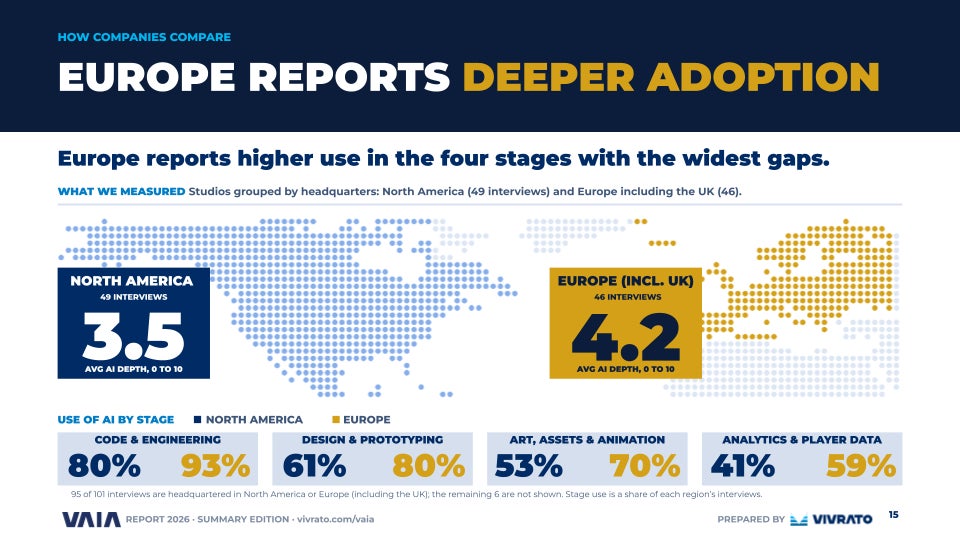
European studios exhibit more extensive AI integration, with an average rating of 4.2 out of 10 (including the UK) compared to 3.5 out of 10 in North America.
European studios tend to use AI more in coding, design, art, and analytics than their North American counterparts.
“The key question is no longer whether game studios use AI,” noted Vivrato’s founder and CEO Adam Boyes. “Most leaders we spoke to confirmed AI adoption in their pipelines.”
“The focus has shifted to how AI is being used, the impact it’s having, and the challenges that teams still face.”
Boyes emphasized, “This year, discussions around AI in games often center on generative AI like chatbots and image generation. However, AI is applied in various ways, from predictive machine learning to automated testing, each yielding different outcomes – making it crucial to establish a clear understanding now.”
Recently, Anna Poulter-Jones from Sheridans provided an overview of current AI regulations in game development.