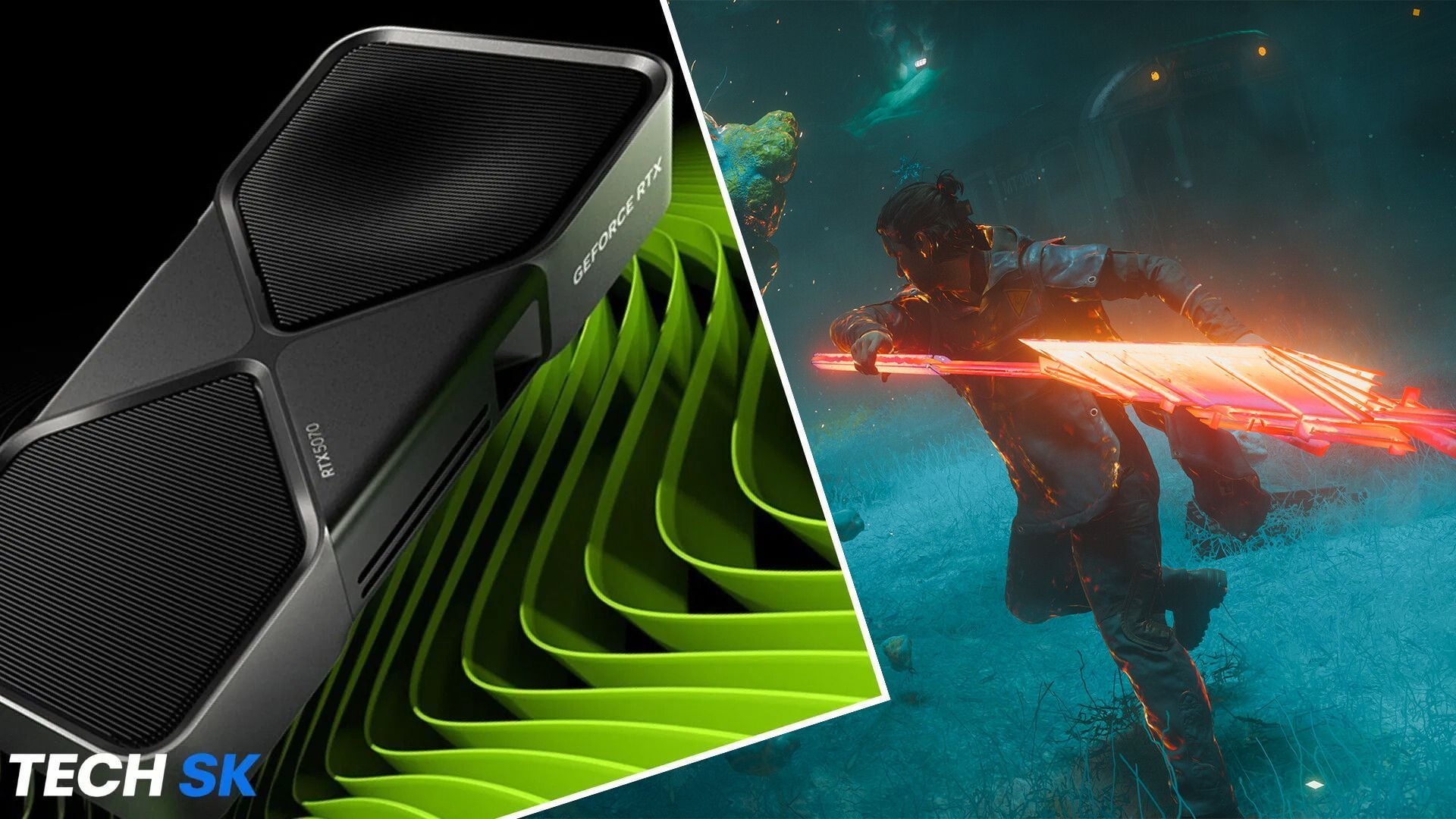
Table of Contents
The Ultimate Guide to Control Resonant Performance on Nvidia RTX 5070 Ti
Are you eager to experience Control Resonant at its peak performance on the Nvidia RTX 5070 Ti? Look no further, as we delve into the intricate details of how this game fares on one of the most powerful GPUs available. Strap in and get ready for an exhilarating ride through the world of Control Resonant.
Unleashing the Power of Nvidia RTX 5070 Ti
Control Resonant is a visually stunning game that truly shines on the Nvidia RTX 5070 Ti, effortlessly surpassing the 300 FPS mark at the highest graphical settings with maximum ray tracing. Powered by Remedy’s Northlight Engine, the game offers a stable and glitch-free experience, showcasing modern ray tracing features such as Path Tracing and Ray Reconstruction.
If you’re curious about how Control Resonant performs on the Nvidia RTX 5070 Ti at 1440p resolution, keep reading to discover our in-depth benchmarks and insights.
Performance Benchmarks and Insights
During our rigorous benchmarking sessions, Control Resonant delivered impressive results on the Nvidia RTX 5070 Ti. Running at 309 FPS on the ultra preset with DLSS Quality, maximum ray tracing, Ray Reconstruction, and 6x frame generation, the game showcased consistent performance across various graphics settings.
Equipped with an AMD Ryzen 5 7600X processor, Nvidia GeForce RTX 5070 Ti GPU, 2×16 GB DDR5 RAM, and a WD SN770 2TB SSD, our test setup provided a comprehensive look at Control Resonant’s performance metrics.
Each gameplay session involved combat, parkour, and skillful ability usage, with a focus on capturing 0.1% low FPS, 1% low FPS, and average FPS data for accurate analysis.
Native Performance Benchmarks
When running Control Resonant at native settings with DLAA and all ray tracing features disabled, we observed varying FPS figures based on the preset. The low preset yielded an average of 109 FPS without frame generation, scaling up to an impressive 356 FPS with 6x frame generation. On the other hand, the ultra preset showcased demanding performance, starting at 85 FPS and peaking at 271 FPS with 6x frame generation.
While the average FPS saw significant improvements with higher frame generation multipliers, the low-percentile figures indicated a nuanced performance story, emphasizing the importance of native rendering capabilities.
Ray Tracing Performance Benchmarks
Enabling all ray tracing features, including Ray Reconstruction and Path Tracing, elevated Control Resonant’s visual fidelity while impacting FPS values. With ray tracing at the highest preset, the game reached an average of 309 FPS with 6x frame generation under DLSS Quality, showcasing the GPU’s prowess in handling complex rendering tasks.
Despite the increase in average FPS, the low-percentile figures highlighted the trade-off between visual fidelity and performance gains, emphasizing the delicate balance required for optimal gameplay experience.
Thermal and Power Draw Analysis
Control Resonant’s demanding nature pushed our PC to its limits during the benchmarks, resulting in audible fan noise and intense thermal conditions. While the CPU temperature occasionally spiked to 81°C-82°C during combat sequences, it generally maintained a range of 60°C-73°C under load.
On the other hand, the Nvidia RTX 5070 Ti exhibited a more stable thermal profile, averaging around 70°C-73°C during gameplay. The GPU’s power draw hovered between 280W and 295W, reflecting its high-performance capabilities under full load.
Conclusion
Control Resonant’s exceptional performance on the Nvidia RTX 5070 Ti showcases the GPU’s ability to handle demanding gaming scenarios with ease. While frame generation multipliers elevate average FPS, the importance of native rendering performance cannot be overstated.
By striking a balance between visual fidelity, performance, and thermal management, players can optimize their Control Resonant experience for smooth and immersive gameplay sessions. Dive into the world of Control Resonant with confidence, armed with the knowledge of how to harness the full potential of the Nvidia RTX 5070 Ti.
Edited by Anindit Sinha