This article is part of AI Week.
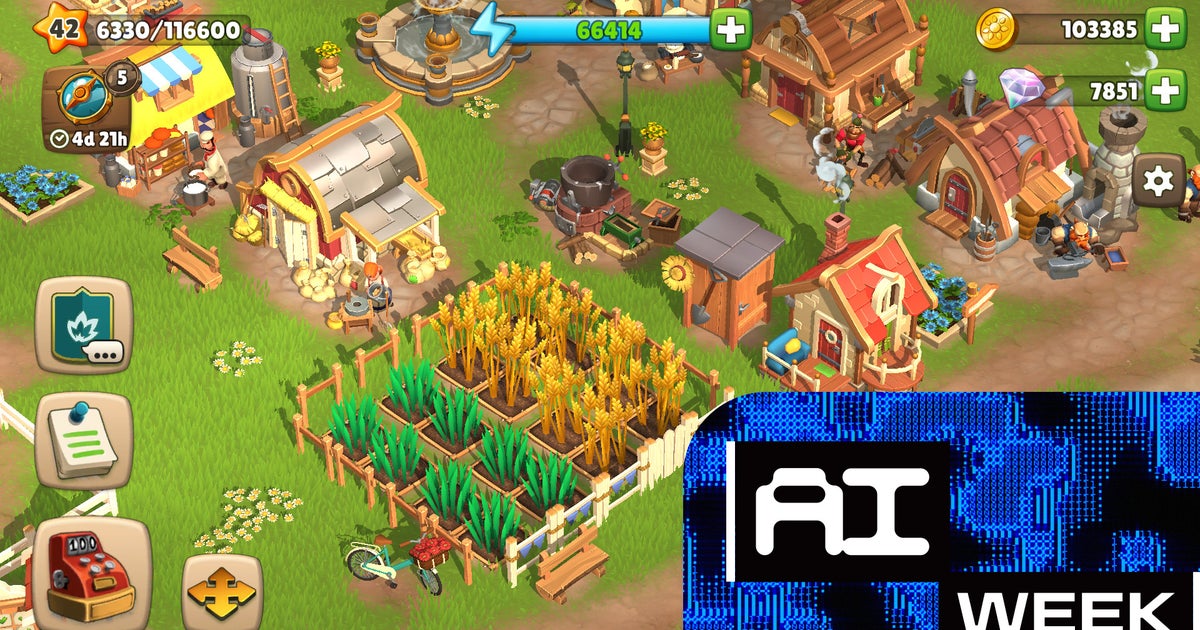
For about a year now, all of the content for the mobile game Sunrise Village has been generated by AI. But far from generating a backlash from players, it seems that no one has realised that anything has changed.
“Player numbers and engagement have remained stable,” says Thomas Lehr, director of engineering at the game’s developer, InnoGames. “The results speak for themselves: zero community complaints about AI or perceived quality differences. It seems players simply haven’t noticed any change.”

But now that the AI cat is out of the bag, is InnoGames braced for a revolt? Will players view the game less favorably than before? “Honestly, some players might have mixed feelings about it – that’s understandable,” muses Lehr. “But what players really care about is a good experience: fun gameplay, engaging stories, polished content. Our playtesting makes sure we deliver that.”
“The alternative was shutting down the game. Given that choice, I think most players would rather keep playing – and a year of stable engagement shows the content works.”
The harsh economic world of mobile free-to-play titles – which require constant content generation and vast marketing spend – means that typically, only the biggest hits survive. Supercell’s Squadbusters is a good example: even with around 58.7 million downloads and approximately $66.2 million in revenue to date (according to AppMagic figures), it was still deemed enough of a failure for development to be halted just 18 months after launch.
Sunrise Village, a cozy farming game first released in 2021, hasn’t exactly been a complete miss for InnoGames: in 2025, it brought in total revenue of between around $160,000 and $190,000 a month, based on AppMagic estimates. That might sound like a lot, but bear in mind that this is before things like the 30% store cut, taxes, and marketing costs are deducted, let alone the salaries of the game’s developers. Furthermore, the game’s monthly active user count peaked a couple of years ago, and its revenue has roughly halved since then.

In short, says Lehr, Sunrise Village was “underperforming financially,” and had reached a point where InnoGames couldn’t justify keeping a team of roughly 25 people working on it full time. “Traditionally, the answer would be to shut down unprofitable games,” he says, “but that’s becoming increasingly unpopular with players, as the Stop Killing Games initiative shows.”
AI offered an alternative. By generating content using AI, the Sunrise Village team has gone from 25 to between two and four people, with the previous developers being moved onto a new project. “Without AI, the game would have been canceled,” says Lehr. “With AI, we can keep it running profitably with a minimal team while maintaining the high quality of content that players expect.”
“That said, we still think the human touch matters also for a game with heavy AI involvement like in this case. We don’t just take whatever the AI produces – we guide it, refine it, and own the final result. AI does the heavy lifting, humans still shape what players actually experience.”
A rapid revolution
Lehr joined InnoGames around 10 years ago, rising from technical project lead to director of engineering. He says he first got interested in AI through ChatGPT and GitHub Copilot around two and a half to three years ago, which he found “genuinely mind-blowing.”
“As an engineer, I didn’t expect that something as complex as coding could be ‘auto-completed’ so effectively. That was the moment I realized this technology would be disruptive.”

Since then, he’s been driving AI initiatives across InnoGames. “We have central teams for art and engineering that serve as AI support, but we also encourage individual research from employees,” he says. “It’s very much a company-wide effort.”
The advancements he’s seen in AI coding over the past couple of years have been astonishingly rapid. “We’ve gone from basic autocomplete to what I call ‘agentic coding’: writing detailed specifications in natural language, then having AI translate that into executable code and tests. This is different from the misleading ‘vibe coding’ – a term that’s become popular for describing approaches where you accept AI output without fully understanding or controlling it. Fast results, but rather random and often unmaintainable.”
Lehr says that on smaller projects, coding agents now outperform humans in both speed and quality. “Tools that used to take days or even weeks are now done in hours.” Humans remain a crucial part of the equation though, as someone still needs to review the code, steer the AI, and make sure the output matches the expectations.
Upfront investment
Getting the AI functionality up and running wasn’t a trivial process. “The initial development took about two months of dedicated engineering effort,” says Lehr, which involved one or two engineers. A key insight was that they were able to use AI to actually create the content-creation tools, which would then use AI to generate content.

The biggest challenges now are the large, legacy codebases, says Lehr, which need to be made explicit and retrievable by the AI. “This is not a solved problem – it requires significant effort and experimental approaches to make codebases ‘AI-friendly’. That’s our current goal: workflows that let agents take a task from the virtual board, plan it, and deliver an implementation for the engineer to review.
The review itself can also be assisted by AI technology. The use of AI in our workflow is akin to a concept artist: starting with AI-generated images instead of a blank canvas allows for efficiency in the creative process. While initially, the introduction of AI did not speed up the process, the progress in AI technology has made it a time-saving tool. Adapting to this new way of working required a learning phase, but now, with the use of Scenario AI, artists at InnoGames can train their own models for better results.
Despite the use of AI in generating initial images, concept artists are still employed at InnoGames. Their role has evolved to focus on fine-tuning AI-generated images, ensuring consistency with the art style, and fixing any errors or inconsistencies. This new workflow has significantly increased efficiency, allowing for quicker progress in game development.
While some artists may have concerns about AI replacing their jobs or skills, InnoGames has addressed these through open communication. The company’s strategy is to use productivity gains to take on more projects and create more value, rather than reducing headcount. AI can also serve as a learning accelerator, helping artists broaden their expertise.
Looking to the future, there is a risk in relying on AI technology owned by external companies. Vendor dependency could pose a challenge if prices increase significantly in the future. However, InnoGames is aware of this risk and is prepared to address it as needed.
There are no expected significant price hikes in the near future, and the associated risks are deemed manageable.
Lehr believes that intense competition among providers will help in keeping prices stable. He mentions the substantial cost reduction of around ten times in the last two years due to advancements in algorithms, hardware, and efficiency. Lehr also highlights that open-source options tend to catch up with cutting-edge models within 6–12 months. He emphasizes that InnoGames remains flexible by not being tied to a specific AI model, allowing for quick shifts to alternatives if prices surge unexpectedly.
Currently, InnoGames intends to enhance its focus on AI. Lehr states, “Following the success of Sunrise Village, we are expanding AI content creation throughout InnoGames.” Tools like the asset labelling system are being introduced to other games, applying insights to actively growing titles rather than just older ones.
AI is seen as a tool to boost productivity at InnoGames, enabling game designers to generate more ideas, iterate faster, and validate concepts swiftly. Artists use AI to explore concepts rapidly, create mood boards, generate variations, and produce initial drafts for refinement. Engineers, on the other hand, develop improved tools for content creators.
“This isn’t solely for struggling games,” Lehr emphasizes. “It’s about achieving better results: expanded feature sets, increased content, quicker iteration cycles, and ultimately enhanced value for players.”
“Those who don’t adopt will find themselves at a severe competitive disadvantage”
Thomas Lehr
Lehr predicts that AI-generated content creation will become prevalent in the mobile sector. He concludes, “The productivity gains are too significant to overlook.” Companies that successfully integrate AI into their workflows can achieve more using the same resources, likely with higher quality outcomes as humans can focus on creative tasks while AI handles repetitive work consistently. This results in more games, increased content, and longer lifespans for popular titles. Those who resist adopting AI may face significant disadvantages in the competitive landscape.
It’s challenging to gauge the extent of AI-first workflows in the mobile industry. Due to the negative responses faced by gaming companies over AI use, very few discuss it openly. Mario Wynands, CEO of PikPok, acknowledges the growing presence of AI adoption in aspects like user acquisition, generative AI UA creative, localization, asset creation, UA campaign management, and game prototyping in hyper-casual games.
Ultimately, consumer acceptance will determine the viability of AI-generated content. While there has been substantial backlash against AI in PC and console gaming, mobile game players have shown relatively little resistance. This distinction highlights the separate nature of the mobile industry from the PC and console sectors. The level of AI-generated content accepted by mobile consumers, as well as the tolerance of artists and designers in the mobile space, remains to be seen.
Lehr views the shift towards an AI-centric workflow as inevitable. He predicts, “Within the next two years, AI-assisted content generation will be standard practice across the industry, especially in mobile games, with continual improvements in tools and accessibility.”
Could you please rephrase the following text?