Table of Contents

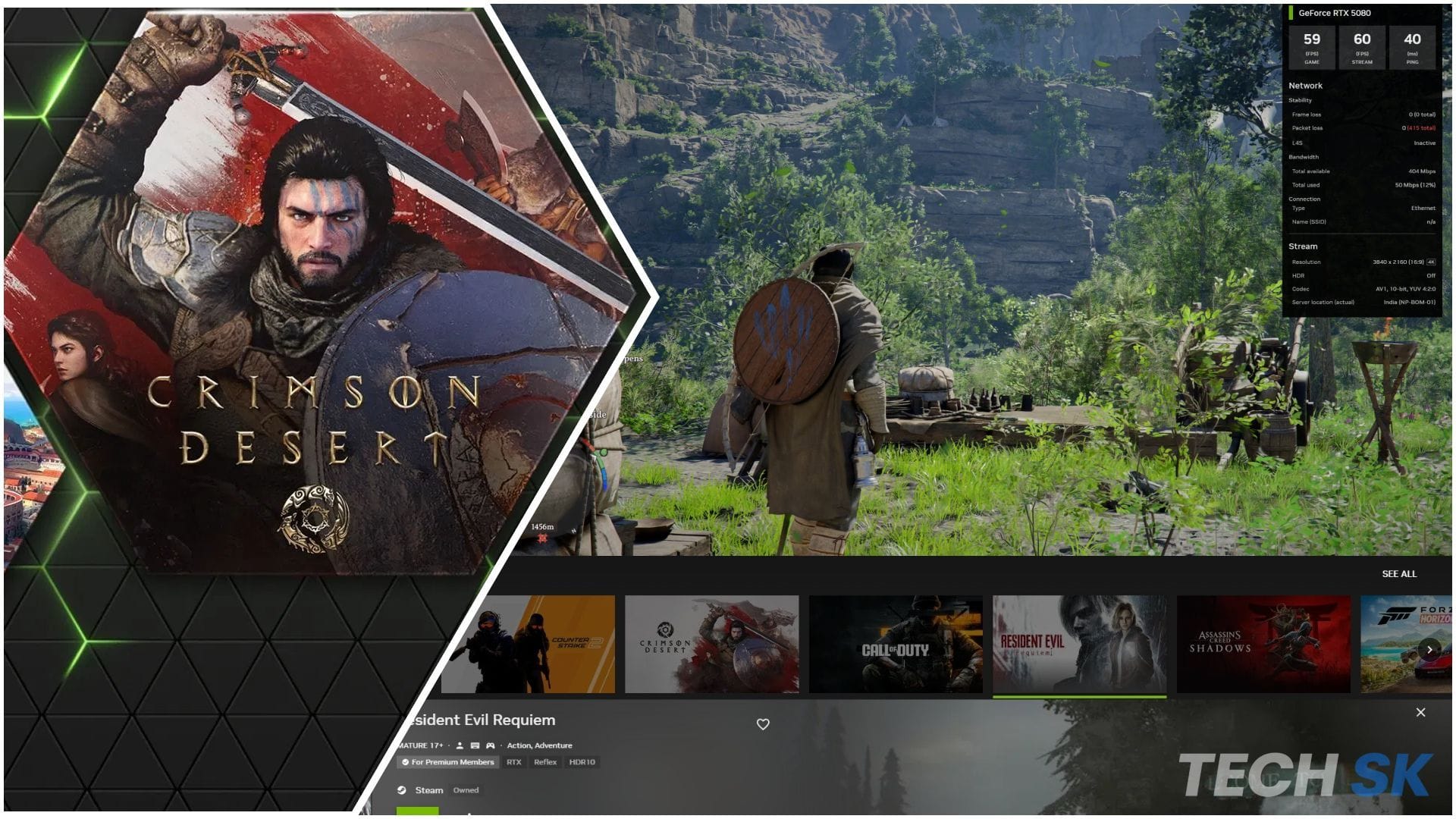
If someone had told me a decade ago that I could enjoy the most demanding AAA games from anywhere without needing a high-powered system, I would have chuckled. Cloud gaming has always piqued my interest, but I’ve remained doubtful. Can it truly revolutionize the way we’ve been gaming for years?
After spending several days with Nvidia’s GeForce Now, the answer isn’t as clear-cut. My recent experiences feel like a sneak peek into the future of gaming, but the burning question remains: is it ready for the present?
GeForce Now Rating: 8.5/10
Pros:
- Exceptional visuals accessible on nearly any device with a good display.
- Unmatched single-player experience with minimal noticeable input lag, rivaling native gaming.
- Great value for the performance and visual quality offered.
Cons:
- Requires a consistently stable and high-speed internet connection.
- Multiplayer may pose challenges due to input lag, more suitable for casual gaming.
GeForce Now: The Pinnacle of Cloud Gaming
Ever since the debut of Crimson Desert, I’ve been engrossed in the world of Pywell, but my current system couldn’t do justice to the game – and I’m equipped with an RTX 4060. This fact alone underscores the game’s demanding nature. When I delved into GeForce Now, I discovered that some games are powered by RTX 5080 GPUs featuring full ray tracing, DLSS 4, and multi-frame generation. Without hesitation, I dived in to witness how the already stunning universe of Crimson Desert would appear on GeForce Now.
I harbored reservations about the server’s capability to handle such a game. Yet, truth be told, I couldn’t discern for a moment whether I was playing the game natively on my PC or streaming it from a server.
This isn’t my initial foray into cloud gaming. I’ve previously tested Xbox Cloud Gaming, and while that service grants game access (unlike GeForce Now), the experience here feels entirely distinct. My recollection of cloud gaming was fraught with lags, jitters, and noticeable delays, leading to my loss of interest. If it struggled with single-player games, multiplayer seemed out of reach entirely.
But times have changed. Despite sounding somewhat technologically inexperienced, this marvel of technology has genuinely exceeded my expectations. Nevertheless, cloud gaming isn’t devoid of flaws. But first, let’s delve into the sheer marvel that GeForce Now offers in terms of visual fidelity – a concept I’m still grappling to fully comprehend.
Unmatched Visuals with Negligible Input Lag
I aimed to maximize visuals without compromising performance. While experimenting with several games, Crimson Desert truly excelled in visual fidelity. Naturally, I desired to witness it at 4K 60 FPS with all settings cranked up. Since my review copy lacked a TV app, I utilized GeForce Now on my PC, setting my TV as the primary display. The experience surpassed my wildest cloud gaming expectations. Even with ray reconstruction activated, I maintained a steady 60 FPS.
Various games were tested at 4K, and even in Resident Evil Requiem, I achieved around 130+ FPS with all settings maxed out. Performance wasn’t a concern with GeForce Now, as the games ran on an RTX 5080 (and occasionally a 4080). The real focus was on stream quality and input lag. For single-player games, the stream maintained a consistent 60 FPS with no noticeable input lag.
However, all this hinged on one crucial prerequisite: a stable, high-speed internet connection. I subscribed to a 100 Mbps plan, conducting initial tests over Ethernet (I’ll touch on Wi-Fi shortly). The app itself indicates if your bandwidth suffices, offering various presets. The Cinematic preset optimizes all settings, delivering the ultimate visual experience.
An Alternative, Not a Substitute
When it comes to multiplayer and competitive games, the scenario becomes more intricate. GeForce Now presents a Competitive preset reaching up to 360 FPS in select titles (like CS2), albeit capped at 1080p. I tested both CS2 and Warzone, and while playable, a catch exists. It feels viable only if you lack a proper setup or simply wish to experiment. In this regard, GeForce Now serves as an alternative for multiplayer gaming, not a replacement, especially where every millisecond of latency and packet loss holds significance.
Reality painted a different picture. I failed to achieve over 250 FPS in Counter Strike 2. An upside of the app is the post-game session report. Regrettably, the data for CS2 was inaccurate. Despite encountering substantial packet loss during the session, it failed to reflect in the report.
In Warzone, I maintained a steady 35 ms ping (stream), the lowest achievable at my location. Yet, engaging in combat felt challenging due to added input delay. Matters marginally improved in Warzone Casual, where most encounters involved bots. However, as I reached endgame, lag resurfaced noticeably. Against real players, the stream visibly struggled. In-game, Warzone displayed around 50 ms ping (in-game), which typically ensures smooth gameplay on a native system, but not here.
Does this imply you can’t engage in competitive games at all? Not entirely. It’s possible, but it doesn’t replace a native setup. If you aim to casually explore multiplayer titles, GeForce Now serves as an excellent starting point. However, if your primary focus lies in competitive FPS gaming, cloud gaming hasn’t quite reached that pinnacle yet.
The Most Cost-Effective OLED Gaming Experience Available
As previously mentioned, initial tests were conducted over Ethernet, with subsequent Wi-Fi trials. It’s worth noting that lacking a 5 GHz network might pose challenges. Testing on both my laptop and phone, the single-player gaming experience remained remarkably akin to native.
Equipped with OLED displays on both devices, I yearned to witness the most demanding worlds. Whether Forza Horizon 5, Assassin’s Creed Shadows, Crimson Desert, or Clair Obscur: Expedition 33, achieving the desired level of visual fidelity was effortless with nothing more than a robust internet connection.
Considering GeForce Now’s price point, juxtaposed with the visual and performance quality across multiple devices, it undeniably emerges as an irresistible deal.
Who Truly Benefits from This?
Distinct from other subscription services, GeForce Now doesn’t bundle games; you must own them. Therefore, the pertinent question arises: who stands to gain the most from this service? The answer isn’t straightforward. For individuals like me seeking the flexibility to game across diverse devices anytime, anywhere, GeForce Now has transformed into a necessity. I’ve only explored the Ultimate tier, hence my insights are confined to that tier. Should NVIDIA sustain this caliber of performance consistently, it’s challenging not to perceive GeForce Now as an inevitable progression.
Reverting to traditional gaming after savoring games I adore at settings I wouldn’t typically venture into feels arduous.
Accessibility constitutes a privilege. Instant access to my entire library at this caliber was an unforeseen delight. Nonetheless, GeForce Now still has ground to cover. It doesn’t supplant native gaming, particularly in multiplayer scenarios. Owning your system remains the gold standard.
Yet, in the realm of single-player experiences, it’s both awe-inspiring and slightly daunting. The current capabilities offer a sneak peek into the trajectory of gaming. If this represents merely the inception, it portends a transformative future for the gaming landscape.
Edited by Debabrata Naiya