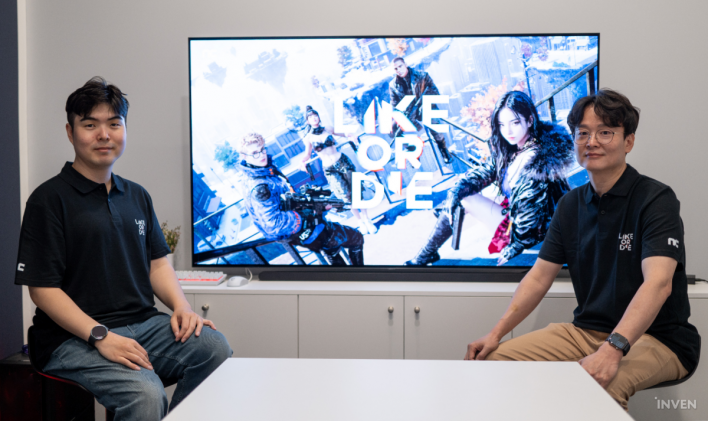
NC’s new title ‘Like or Die’ is a team-based survival FPS where four teams of four—16 players in total—clash against each other. Each team defends its designated respawn base, the ‘Nexus,’ while destroying enemy Nexuses to fight until only one team remains. On top of this, the game incorporates ‘Block Action,’ allowing players to stack blocks to modify the terrain mid-combat. Kim Hwan, head of the NEXT IP Division, shared that when development began, CEO Kim Taek-jin told the team, “I won’t interfere, so go ahead and make something great.”
📢GAMESCOM
Title: Like or Die Developer: NC Main Tags: #Team #Survival #PVP #Steam #FPS 📝 ‘Like or Die’ is a team-based survival FPS where four teams of four—16 players in total—clash against each other.
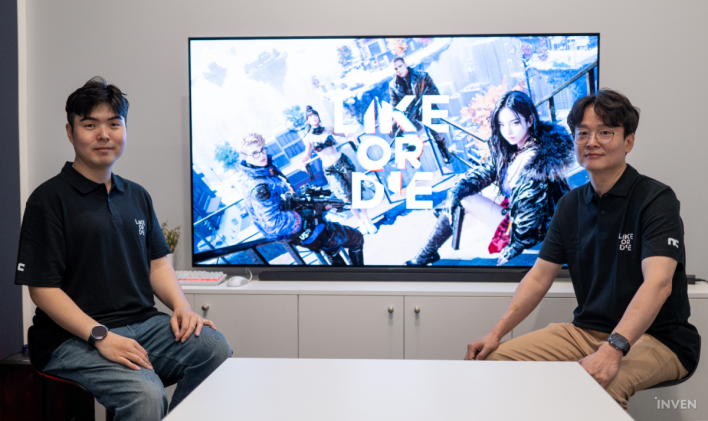
The game was first unveiled via a trailer on August 25 (local time) during Opening Night Live (ONL), the eve showcase of Gamescom 2026 held in Cologne, Germany. NC held its first media interview on site the following day, August 26, where Head of Division Kim and Development Director Jeon Hyeong-soo explained the game’s core structure. ‘Like or Die’ is being developed on Unreal Engine 5, targeting PC and console platforms.
The main mode is ‘Nexus Survival.’ Teams whose Nexus is destroyed can no longer respawn, while teams that defend their base keep coming back to life. Strategies that target the enemy’s Nexus right from the start are also viable.
Four Nexus locations are currently fixed on the map, and one is assigned to each team upon entry. Which team holds which position is visible to everyone via the minimap. Director Jeon noted that allowing players to directly choose their Nexus location remains a potential feature for future expansion.
Matches revolve around resources. Resource generators are located at each base, with additional facilities scattered throughout the field. Players use gathered resources at the base shop to purchase guns, gadgets, and blocks. Blocks are not infinite and can only be obtained through shop purchases. Weapons are not locked to characters; instead, players build their arsenal step-by-step through out-of-game loadout customization and in-game shop purchases. Firearms are modeled after real-world counterparts.
“Not building structures, but reshaping terrain through Block Action”
Blocks are placed using a ‘Block Gun.’ They can be used to construct bridges in mid-air or climb upward, wrap around one’s Nexus for defense, or forge aerial pathways to infiltrate enemy territory.
When asked about how it differs from existing shooters like ‘Fortnite,’ Director Jeon answered, “It’s terrain, not structures.” Rather than combining stairs and walls to build complex edifices, the concept is about stacking simple individual blocks to shape the battlefield terrain itself. He added, “In that sense, we think it will be much more accessible.”
Head of Division Kim highlighted that Block Action is seamlessly integrated into combat as a key strength. He explained, “Usually, building-mode games force players to focus solely on building once they enter that mode. In ‘Like or Die,’ the advantage is that you can smoothly shoot opponents while placing blocks mid-fight.”
Weapon swap speed between the Block Gun and firearms remains subject to tuning. Director Jeon noted, “There is a balance consideration around how much players can dodge by swapping immediately when hit,” adding that they will refine this alongside TTK (time-to-kill) through playtests. Currently, players can already react to taking damage by building blocks to leap upward or block line of sight.
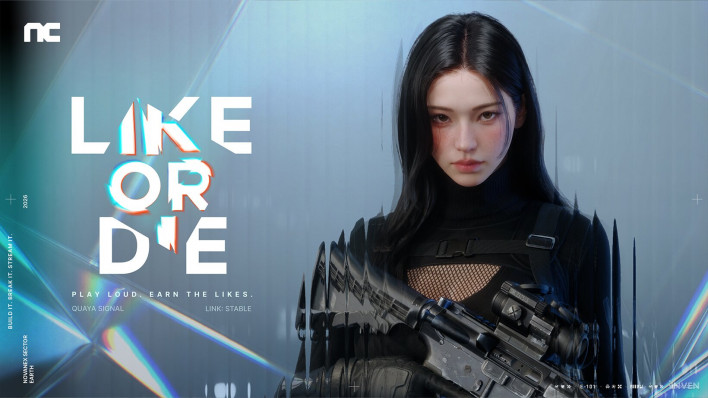
Variables are introduced by ‘Sponsors.’ A different sponsor is selected for each match, creating a roguelike structure where distinct mechanics and items appear each session. The trailer scene where the protagonist eats a flower, turns the floor into a bed of flowers, and transforms is a result of a sponsor effect. Director Jeon explained that these fantasy elements are layered onto session-based play atop real-world firearms. ‘Lucky Boxes’ and ‘Airdrops’ also spawn randomly on the field, offering rewards of varying rarity.
Mechanics are also being prepared to prevent teams from immediately collapsing once their Nexus is destroyed. Options under consideration include missions and passives that grant bonuses on a player’s final life. Director Jeon said they are balancing whether to encourage sneaky survival or offer greater rewards for taking risks and attacking.
Addressing concerns that matches might degenerate into purely defensive play, Head of Division Kim pointed to airdrops as the solution. He explained, “There are cases where game-changing weapons are dropped in locations that players cannot secure if they only defend their Nexus, so teams that purely turtle won’t necessarily have a high win rate.”
If a match drags on, a mechanic shrinks the battlefield. However, Director Jeon described this as a final failsafe in case the Nexus battles remain unresolved. The target match length is over 10 minutes, though matches can end in around 5 minutes if teams opt for early rushes.
A platform broadcasting Earth, set in a parallel universe’s Seoul
The worldbuilding originates from live streaming. In this lore, a cosmic streaming conglomerate expands its reach to Earth, where Earthlings join as streamers to compete, win, and aim to become intergalactic stars. The setting serves as a sort of Earth streaming branch run by this corporation. The main map is inspired by a parallel universe’s Seoul—a stage created when the platform edited modern Seoul to suit its own needs while acquiring content in new territories.
There are no fixed hero characters.
Director Jeon clarified that the game in question is an avatar game, not a hero shooter. Players have the opportunity to customize their avatars prior to entering a match. The emphasis on visual diversity sets it apart from traditional military shooters, with playable characters currently limited to Earthlings.
The impact of the streaming concept on active gameplay is still under adjustment. Chat reactions, initially featured in the trailer, have been tested in-game but have since been removed from the current build. Director Jeon explained that during matches, core gameplay takes precedence, leading to the relocation of such presentation elements to out-of-game systems.
Instead of real-time chat reactions, in-game performance is now translated into post-match highlights and scores. These scores contribute to player relationships with Sponsors, allowing them to unlock cosmetic rewards. Social features like sharing highlight clips are currently in the planning stages.
The project commenced two years ago and boasts a development team comprised of veterans from titles such as ‘A.V.A,’ ‘PUBG: BATTLEGROUNDS,’ ‘Crossfire,’ and ‘Tom Clancy’s Rainbow Six Siege.’
Head of Division Kim highlighted the team’s unwavering focus on core shooting mechanics, stating that solid gunplay is of utmost importance. He reassured, “Our primary goal is to deliver exceptional gunplay mechanics, a fundamental aspect players can anticipate.”
In addition to the main game mode, Nexus Survival, the team is also working on PvE modes, streamlined PvP, and event modes. Director Jeon revealed that the development process will progress through FGT, CBT, and OBT phases, with closed testing slated for the upcoming year and a target release date set for the following year. Head of Division Kim stressed the team’s commitment to ensuring the game is enjoyable, stating, “We will not launch the game if it does not meet our standards of fun.”