Table of Contents
Understanding Ratings
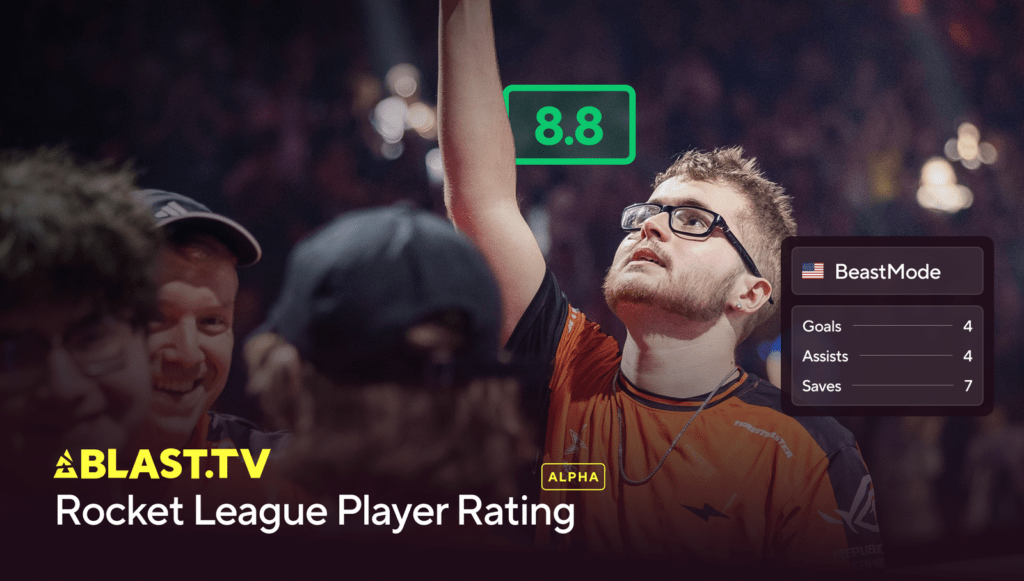
The purpose of our rating system is to offer a more comprehensive evaluation of a player’s performance in a professional Rocket League match. Beyond traditional stats like goals and assists, we aim to provide a clear insight into how a player truly impacts the game.
Our Rating system is designed to compare a player’s performance to expected statistical values and adjust their rating accordingly. It is important to note that the rating is calculated on a per-game basis and resets at the start of each new game.
Why Out of 10?
In our initial approach, we adopted a traditional sports rating scale. Each player begins with a baseline score of 6.5 at the start of a match, with their actions during the game either raising or lowering this rating.
An average performance falls between 6.0 and 7.0, while ratings above 7.0 indicate a strong performance and ratings below 6.0 reflect a subpar performance. This method was inspired by platforms like Sofascore and Whoscored.
A single number (w two decimals) to rule them all
Factors in Our Ratings
Our rating system considers 8 core components, with each factor weighted based on its impact and the unique dynamics of each game.
These components include:
- Goals
- Assists
- Saves
- Shots
- Demos
- Contests (50/50s)
- Kickoffs
- Pressure
These components were chosen based on an analysis of over 30,000 RLCS games, identifying their correlation with winning and adjusting their influence on the final rating accordingly. We also include elements of lower impact that consistently demonstrate strong individual play.
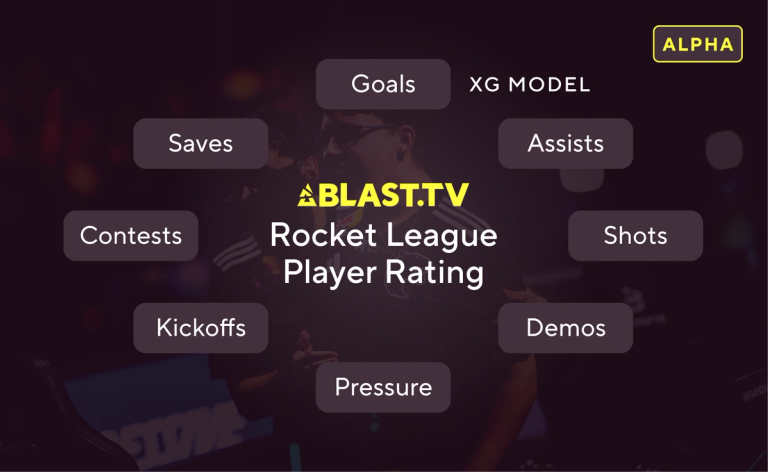
Our core components
In-Depth Look at Components
Goals
Goals are pivotal in determining a team’s and player’s success in Rocket League. With an average of approximately four goals per game, they significantly impact a player’s Rating.
Each goal scored is assessed based on:
- xG (Expected Goals): By utilizing a custom ML model, we evaluate the expected goal probability of each shot leading to a goal and adjust the goal’s impact accordingly. For instance, scoring a goal that defies expectations carries more weight than a simple tap-in.
- Game Context: Considering the unique context of each game, we assess the significance of each goal within the match flow and adjust the rating based on its importance. For example, scoring an overtime winner holds more value than scoring in a lopsided game.
Assists
Recognizing the playmaking role in Rocket League, assists play a crucial part in a player’s contribution to the game.
Assists are evaluated similarly to goals, incorporating our xG model to adjust their impact on the rating. Setting up a scoring opportunity for a teammate carries more weight than a speculative shot resulting in a goal.
Shots & Saves
Every shot and save is analyzed based on the xG of the chance and the difficulty of the save. A player preventing a high-xG shot earns a substantial rating boost, while standard saves contribute positively but to a lesser extent.
Failing to convert a high-xG opportunity leads to a notable deduction from the player’s rating.
Demos
Demolitions play a significant role in controlling the game, and each demo is factored into the player’s rating. The timing of a demo in key moments of the game influences the rating, with a demo impacting a goal scoring or conceding situation receiving a higher bonus.
Contests (50/50s)
Player battles for ball possession are crucial in Rocket League. We monitor these moments and their outcomes to make incremental yet meaningful contributions to a player’s rating.
We also assess these contests in relation to significant events like goals, attributing greater weight to contests that result in a goal.
Pressure
The ability to maintain pressure on the opponents can dictate the game’s outcome.
By tracking player and ball positions throughout the game, we measure the pressure exerted by each player. Positive or negative outcomes influenced by this pressure impact the player’s rating accordingly.
Conclusion
Our Rating system aims to provide insights into player performance on the Rocket League arena. While we continuously refine and enhance our system for accuracy, the best assessment of a player’s performance ultimately comes from watching the matches firsthand. We welcome your feedback and thoughts in our discord or on the RLCS subreddit.