Table of Contents
When it comes to Unreal Engine 5 games, there’s often a concern about the hardware requirements and performance issues that can arise. However, in the case of Saber Interactive’s latest release, "Clive Barker’s Hellraiser: Revival," things are looking up. This survival horror game not only looks good but also performs relatively well on a variety of systems, with minimal shader compilation stutters and traversal hitches.
Gameplay And Technical Overview Of Clive Barker’s Hellraiser: Revival
"Clive Barker’s Hellraiser: Revival," launched on October 8, 2026, plunges players into a nightmarish world filled with cultists, grotesque enemies, and the iconic Cenobites. Set in the eerie universe of Clive Barker’s "Hellraiser," the game follows Aidan as he ventures into the Labyrinth to save his girlfriend, Sunny, using the powers of the Genesis Configuration puzzle box.
Running on Unreal Engine 5.6.1.0, the game leverages modern rendering features like Nanite Virtualized Geometry, Lumen diffuse Global Illumination, and Virtual Shadow Maps. While it may not push the visual boundaries of UE5, the game strikes a balance between graphical fidelity and performance, creating a chilling atmosphere that complements the gameplay.
Shader Compilation, Traversal Stutters, And General Performance Impressions
One of the standout features of "Clive Barker’s Hellraiser: Revival" is its optimized shader compilation process, reducing stutter during gameplay. Traversal hitches are minimal and infrequent, providing a smoother gaming experience overall. While performance may vary between systems, the game manages system resources well, ensuring a relatively smooth experience for most players.
Temporal Upscaling, Frame Generation, And Latency Reduction
In terms of visual enhancements, the game offers a range of Temporal Anti-Aliasing and Upscaling technologies, including Unreal Engine 5’s Temporal Super Resolution and NVIDIA DLSS Super Resolution. With options like resolution scaling sliders, players can fine-tune their graphical settings to balance performance and visual quality.
In conclusion, "Clive Barker’s Hellraiser: Revival" may not be the most visually ambitious Unreal Engine 5 game, but it delivers a chilling horror experience with solid performance. With optimized configurations and a range of visual enhancements, players can immerse themselves in a nightmarish world brought to life by the power of UE5.
An Expert Guide to Enhancing Game Performance with Super Resolution Technologies
When it comes to optimizing game performance, utilizing super resolution technologies can be a game-changer. These technologies enhance graphics without compromising performance, making them a valuable tool for gamers looking to maximize their gaming experience. In this guide, we will explore the top super resolution technologies available for different GPUs and how they can help you achieve the best gaming performance.
Top Super Resolution Technologies for Different GPUs
- NVIDIA GeForce RTX GPUs: DLSS Super Resolution.
- AMD Radeon RX 7000/9000 Series GPUs: FSR Upscaling, particularly the newer ML-based FSR 4.1 implementation.
- Intel Arc GPUs: XeSS Super Resolution.
- Other compatible GPUs: Unreal Engine 5 TSR.
Choosing the right mode, whether Quality, Balanced, or Performance, can significantly impact your gaming experience. It is crucial to find the optimal balance between resolution and performance based on your GPU and gaming preferences. Lowering the internal resolution can boost performance but may result in a loss of fine details and clarity.
While frame generation support varies, DLSS Frame Generation stands out as a key technology integrated into games. NVIDIA’s App overrides offer additional Multi Frame Generation factors, enhancing the gaming experience on compatible RTX GPUs. However, AMD FSR Frame Generation and Intel XeSS Frame Generation are currently not supported in most games, leaving room for third-party solutions like OptiScaler.
When it comes to latency, NVIDIA Reflex Low Latency is a valuable feature, although its integration with DLSS Frame Generation can be limiting. Native support for AMD Anti-Lag 2 and Intel Xe Low Latency is currently missing, highlighting areas for improvement in future updates.
It is essential to prioritize a consistent frame rate and image stability before enabling frame generation technologies to ensure a seamless gaming experience.
Official PC System Requirements
The official minimum and recommended system requirements for Clive Barker’s Hellraiser: Revival are as follows:
| Component | Minimum | Recommended |
|---|---|---|
| Operating System | Windows 10 64-bit, version 22H2 or newer | Windows 10 64-bit, version 22H2 or newer |
| CPU | Intel Core i5-8400 / AMD Ryzen 5 1500X | Intel Core i5-12400F / AMD Ryzen 5 5600X |
| RAM | 8 GB | 16 GB |
| GPU | NVIDIA GeForce GTX 1660 / AMD Radeon RX Vega 64 8 GB | NVIDIA GeForce RTX 3060 / AMD Radeon RX 6600 XT |
| Storage | 80 GB available | 80 GB available |
| Additional Notes | SSD recommended | SSD recommended |
These requirements are well-balanced for a modern Unreal Engine 5 game, with the recommended specifications offering a smooth gaming experience. However, the absence of specific target resolution, frame rate, graphics preset, or upscaling mode details can impact performance expectations.
Investing in an SSD is advisable, as it can improve asset streaming and overall frame time consistency, contributing to a more seamless gaming experience.
Test Systems and Methodology
Our performance analysis utilized two PC configurations to assess different aspects of the game:
| Component | Desktop: Individual Graphics Settings Testing | Laptop: CPU And Optimized Graphics Settings Testing |
|---|---|---|
| CPU | Intel Core i7-14700K | Intel Core i7-12700H |
| GPU | NVIDIA GeForce RTX 4090 24 GB | NVIDIA GeForce RTX 4060 Laptop GPU 8 GB |
| RAM | 32 GB DDR5-7000 | 16 GB DDR4-3200 |
| Storage | 2 TB PCIe 4.0 NVMe SSD | 1 TB PCIe 4.0 NVMe SSD |
| Operating System | Windows 11 26H2 | Windows 11 26H2 |
Our testing scenarios covered individual graphics settings comparisons and CPU-focused benchmarks, providing insights into performance under varying conditions. The use of CapFrameX allowed for accurate performance monitoring and analysis.
CPU Performance Testing
Clive Barker’s Hellraiser: Revival demonstrates moderate CPU demands despite utilizing Unreal Engine 5’s advanced features. Our CPU-focused benchmark revealed the game’s performance on our laptop system, showcasing stable frame rates and minimal CPU-related hitches.
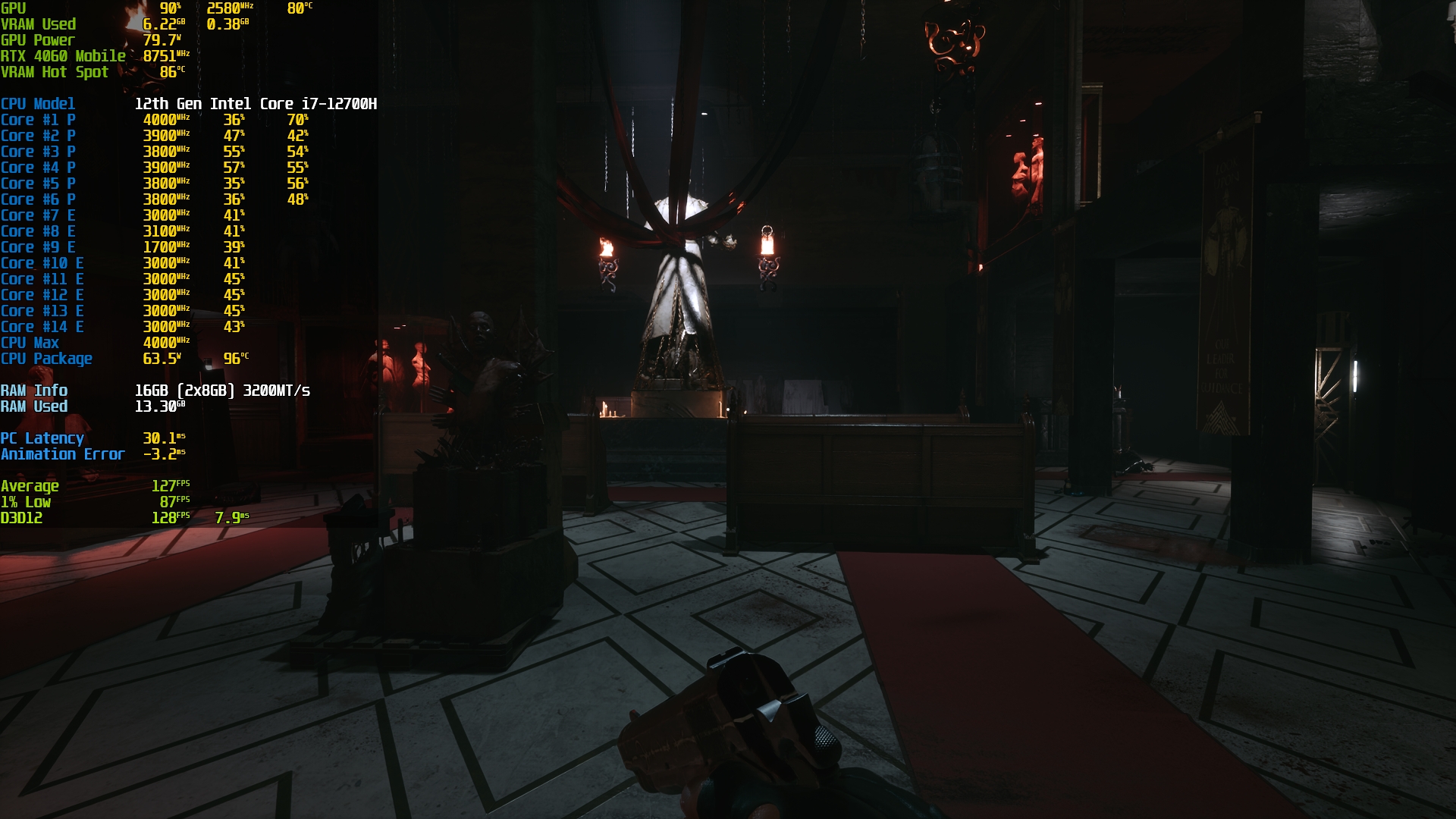
The benchmark results showcased excellent average frame rates and minimal frame time deviations, indicating the game’s efficient CPU utilization. While some traversal stutters were noted on the laptop system, overall performance remained solid across different scenarios.
These findings underscore the importance of a capable CPU in achieving optimal performance in Clive Barker’s Hellraiser: Revival. With a solid CPU and GPU combination, gamers can enjoy a smooth and immersive gaming experience.
Are you ready to take your gaming experience to the next level with Clive Barker’s Hellraiser: Revival? This game offers a deep dive into graphics settings that can enhance your gameplay and visual experience. Let’s explore how tweaking these settings can optimize your performance and image quality.
## A Deep Dive Into Clive Barker’s Hellraiser: Revival’s Graphics Settings
When it comes to graphics settings, many gamers wonder how much of an impact they truly have on the overall experience. In the case of Clive Barker’s Hellraiser: Revival, most settings have surprisingly little effect on GPU-limited performance or overall image quality. This means that adjusting these settings may not always result in significant improvements.
### View Distance
View Distance in Clive Barker’s Hellraiser: Revival controls how far environmental objects and scene details remain visible. Surprisingly, lowering this setting did not produce a noticeable performance benefit in our tests. Therefore, we recommend keeping it at the Epic level for the best visual experience.
### Anti-Aliasing
Anti-Aliasing is a crucial setting that affects the quality of the game’s TSR. During our testing, we found that a Medium setting provided the best balance between visuals and performance. Higher settings offered diminishing returns, while lower settings compromised image quality.
### Shadow Quality
Shadow Quality influences the fidelity of the game’s Virtual Shadow Maps. In our comparisons, we discovered that a Medium setting struck the best compromise between visual fidelity and GPU cost. Therefore, we recommend keeping Shadow Quality at the Medium level for optimal performance.
### Texture Quality
Texture Quality is a setting that should be adjusted based on available VRAM rather than raw GPU performance. Our testing revealed that at 1440p, Medium, High, and Epic textures require approximately 10 GB of VRAM, while Low textures need around 8 GB. It’s crucial to match your VRAM budget with the appropriate texture quality setting to avoid performance issues.
### Post-Processing
Post-Processing controls various visual effects in the game, such as bloom and color correction. Interestingly, altering this setting had minimal impact on performance during our tests. We recommend adjusting it based on personal preference, with the option to disable Motion Blur for a clearer image.
### Global Illumination
Global Illumination is a significant setting that can greatly impact the game’s visual presentation. We recommend keeping this setting at a high level to enhance the overall lighting and atmosphere of Clive Barker’s Hellraiser: Revival.
In conclusion, optimizing your graphics settings in Clive Barker’s Hellraiser: Revival can elevate your gaming experience to new heights. By carefully adjusting these settings based on our recommendations, you can achieve a perfect balance between performance and visual quality. Embrace the horror and beauty of this game with the right graphics settings tailored to your preferences. ### Unlocking the Visual Potential of Unreal Engine 5: A Deep Dive into Graphics Settings Optimization
As gamers, we all want our favorite titles to look stunning while maintaining optimal performance. Unreal Engine 5 has set new standards for visual fidelity, and understanding how to tweak its graphics settings can make a world of difference. Let’s delve into the intricacies of optimizing graphics settings for **Clive Barker’s Hellraiser: Revival** to strike that perfect balance between eye candy and smooth gameplay.
#### The Influence of Global Illumination
Global Illumination plays a crucial role in shaping the ambiance and depth of a game world by controlling how indirect light behaves. This impacts everything from the way light interacts with surfaces to the perception of depth in dark environments. When it comes to choosing the ideal setting, the High option stands out as a clear winner. It strikes a harmonious balance between visual quality and performance, making it a no-brainer choice for most systems.
#### Reflection Quality: Striking the Perfect Balance
Reflection Quality is another key setting that directly affects the realism of reflective surfaces in the game. Opting for the High setting ensures that you enjoy crisp and accurate reflections without compromising performance. By harnessing the power of software Lumen specular reflections, this setting delivers a visual treat that is hard to resist. Say goodbye to unnecessary performance overheads and embrace the beauty of high-quality reflections.
#### Effects: Enhancing the Visual Spectacle
Effects are the soul of a game’s visual presentation, adding depth and immersion to the overall experience. While the Epic setting may seem enticing, the High option offers comparable visual fidelity with smoother performance. Don’t let unnecessary performance bottlenecks hinder your gameplay; choose High for an optimal balance between stunning effects and seamless gameplay.
#### Foliage Quality: Bringing the Environment to Life
Foliage Quality dictates the rendering quality of vegetation and environmental details, enhancing the richness of the game world. Opting for the Epic setting ensures that every leaf and blade of grass is rendered with utmost detail and realism. With minimal performance differences observed between settings, going all-in with Epic is the way to go for a truly immersive experience.
#### Shading Quality: Crafting Realistic Environments
Shading Quality influences surface shading, lighting, shadows, and reflections, shaping the visual appeal of the game world. Despite its broad scope, lowering this setting below Epic may not yield significant performance gains. Embrace the beauty of high-quality shading with the Epic setting to elevate the visual fidelity of your gameplay experience.
### Final Thoughts: Striking the Perfect Balance
In conclusion, optimizing graphics settings for **Clive Barker’s Hellraiser: Revival** is a delicate dance between visual fidelity and performance. By making informed choices and leveraging the power of Unreal Engine 5’s cutting-edge features, you can unlock the full potential of the game while maintaining smooth and immersive gameplay. Remember, the key lies in finding that perfect balance that suits your system configuration and personal preferences. So dive in, tweak those settings, and immerse yourself in a visually stunning gaming experience like never before.
The Future of Gaming: Clive Barker’s Hellraiser: Revival
As the gaming industry continues to push the boundaries of technology and innovation, one title that stands out is Clive Barker’s Hellraiser: Revival. This horror game, built on the Unreal Engine 5, offers a thrilling and immersive experience for players. But what sets it apart from other games on the market?
Technical Limitations and Potential Improvements
While Clive Barker’s Hellraiser: Revival is a standout title, there are some technical limitations that players should be aware of. For instance, native HDR is absent, NVIDIA Reflex Low Latency cannot be enabled independently of DLSS Frame Generation, and AMD/Intel players do not have integrated frame generation or their respective latency reduction technologies. These limitations may impact the overall gaming experience for some players.
However, there is still room for improvement in these areas. As the gaming industry evolves, we can expect developers to address these limitations and provide a more seamless gaming experience for all players. The inclusion of native HDR, independent NVIDIA Reflex Low Latency, and integrated frame generation for AMD/Intel players would greatly enhance the overall gameplay experience.
Optimized Settings and Performance
Despite these technical limitations, our optimized settings for Clive Barker’s Hellraiser: Revival have shown a significant improvement in performance. With a 33% higher average performance on the RTX 4060 laptop while retaining most of the Epic preset’s visual quality, players can enjoy a smooth and enjoyable PC experience without the need for cutting-edge hardware. This is a testament to the game’s optimization and the potential for even better performance with future updates.
Conclusion
Clive Barker’s Hellraiser: Revival is a game that pushes the boundaries of what is possible in the gaming industry. While there are some technical limitations that need to be addressed, the overall experience is one that is both thrilling and immersive. With optimized settings and impressive performance gains, this game is a must-play for horror enthusiasts and gamers looking for a unique and engaging experience.

About the author: Sebastian Castellanos is a data scientist with a passion for PC gaming hardware and software. His technical expertise and love for gaming shine through in his articles and guides on Wccftech.
Follow Wccftech on Google to get more of our news coverage in your feeds.
H2: The Rise of Virtual Reality Gaming
Virtual reality gaming has quickly become one of the most exciting and innovative developments in the gaming industry. With the ability to transport players into immersive virtual worlds, VR gaming offers a level of realism and interactivity that was once only seen in science fiction movies.
H3: The Technology Behind VR Gaming
At the core of virtual reality gaming is sophisticated technology that includes high-resolution displays, motion tracking sensors, and immersive sound systems. These components work together to create a seamless and realistic gaming experience that can truly transport players to another world.
H3: The Impact on Gaming Experience
The impact of virtual reality gaming on the overall gaming experience cannot be overstated. By providing players with a truly immersive experience, VR gaming has the potential to revolutionize the way we play and interact with games. From exploring fantastical worlds to engaging in intense combat, virtual reality gaming offers a level of immersion that simply cannot be matched by traditional gaming experiences.
H3: The Future of VR Gaming
As technology continues to advance, the future of virtual reality gaming looks brighter than ever. With the development of more powerful hardware and innovative software, VR gaming is poised to become even more immersive and realistic in the years to come. From virtual reality arcades to at-home VR setups, the possibilities for virtual reality gaming are endless.
In conclusion, virtual reality gaming has the potential to completely transform the gaming industry and the way we experience games. With its immersive technology and limitless possibilities, VR gaming is an exciting and innovative development that is sure to shape the future of gaming for years to come.